Meta Muse_ AI-Powered Growth for Indian Businesses

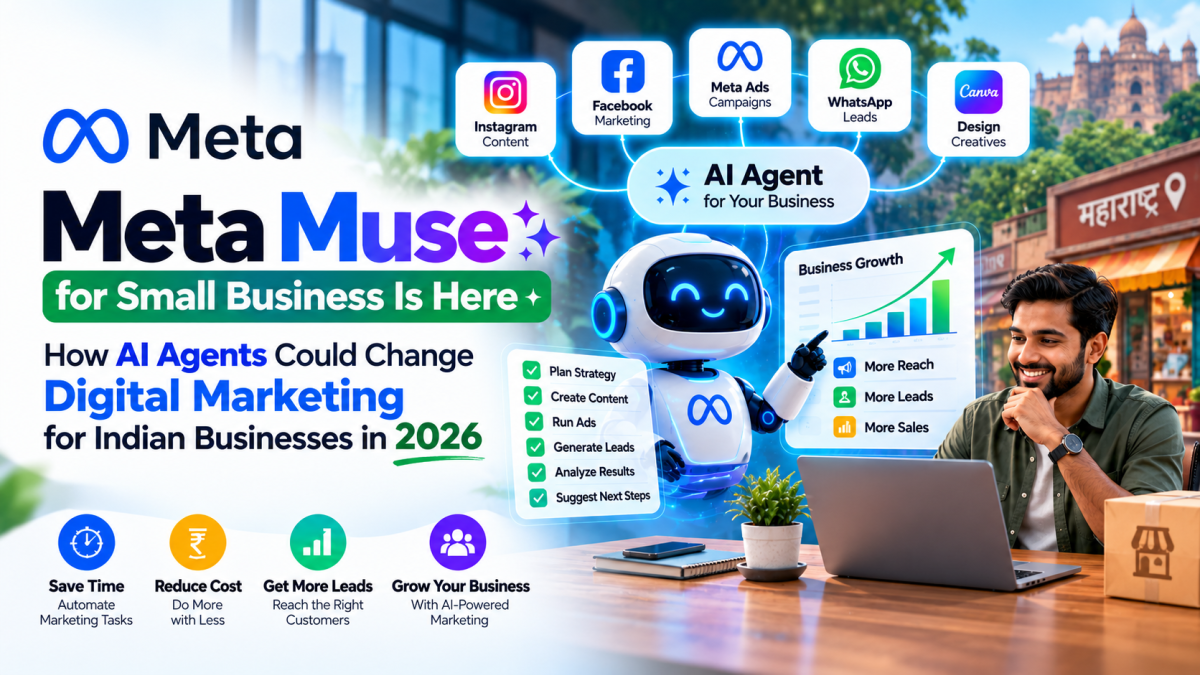
Meta Muse for Small Business Is Here: How AI Agents Could Change Digital Marketing for Indian Businesses in 2026

AI MARKETING • SMALL BUSINESS • 2026

Meta Muse for Small Business Is Here: What Indian Businesses Need to Know

AI in digital marketing is moving from simple content generation toward goal-driven, connected workflows. Here’s what Meta Muse could mean for Indian small businesses, marketers, ads, lead generation and everyday marketing operations.
AI MARKETING • SMALL BUSINESS • 2026

Meta Muse for Small Business Is Here: What Indian Businesses Need to Know

AI in digital marketing is moving from simple content generation toward goal-driven, connected workflows. Here’s what Meta Muse could mean for Indian small businesses, marketers, ads, lead generation and everyday marketing operations.
Search intentInformational → Commercial Investigation
Primary keywordAI marketing for small businesses
Published focusIndian SMBs • Jalgaon • 2026

Artificial intelligence in digital marketing is moving beyond:

"Ask AI to write something."

The next phase is increasingly:

"Give AI a business goal and let it work across your tools."

That shift became much more visible on September 29, 2026, when Meta announced Muse for Small Business.

Meta says Muse can connect to business tools and accounts including:

  • Instagram professional accounts
  • Facebook Pages
  • Meta ad accounts
  • Canva
  • Shopify
  • QuickBooks
  • Slack
  • Zoom
  • Asana
  • Dropbox
  • Notion
  • Klaviyo
  • Stripe
  • Figma
  • HighLevel

Meta describes the product as an AI agent that can work toward goals such as running a business or finding new customers. It also says users remain in control and that nothing publishes, sends or spends without approval.

This is important for small businesses because many owners don't have separate teams for:

Marketing + Design + Ads + Analytics + Customer Support + Operations.

But there is an important distinction:

AI can reduce repetitive work. It does not remove the need for marketing strategy, customer understanding, human judgment or accountability.
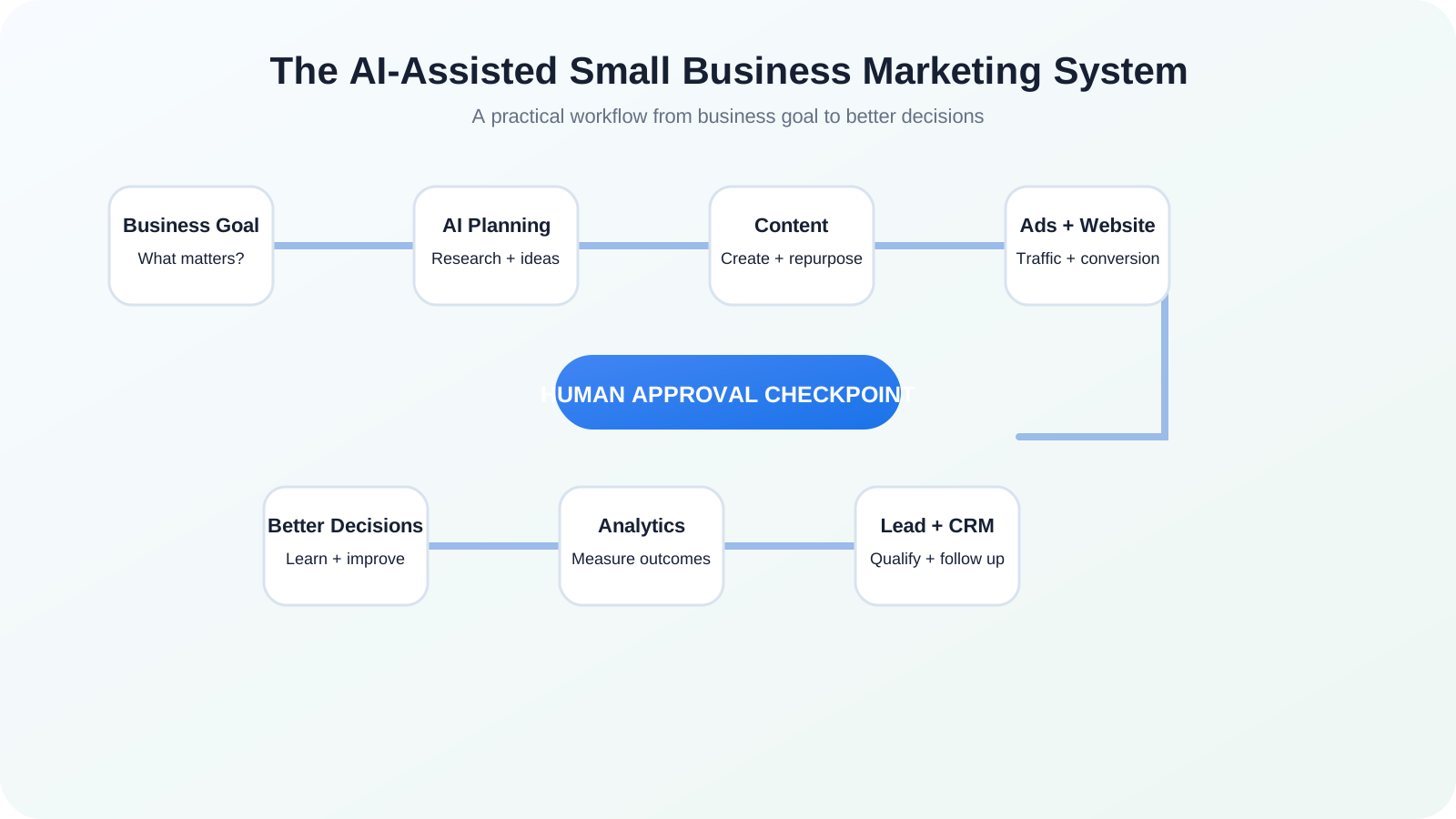
AI-assisted small business marketing workflow from business goal to better decisions

What Is Meta Muse for Small Business?

Muse is an AI agent from Meta that has now been expanded with capabilities aimed at small-business users.

Instead of simply answering:

"How do I create a Facebook ad?"

an agent-oriented system can work with connected business context and help with broader goals.

For example:

"Help me find more customers."

The potential workflow can involve:

Business information → Existing data → Analysis → Recommendations → Draft work → Human approval

This is fundamentally different from using AI as a simple chatbot.

AI Assistant vs AI Agent: What's the Difference?

This distinction matters.

Traditional AI Assistant

You ask:

"Give me 5 Instagram post ideas."

AI gives you:

5 ideas.

You then:

  • Create the design
  • Schedule the post
  • Analyze results
  • Decide what to create next

AI Agent

You could give an agent a broader objective:

"Help me improve my social media marketing."

The system may be able to:

  • Review connected information
  • Analyze performance
  • Identify opportunities
  • Suggest a plan
  • Draft content
  • Work with connected tools

The exact capabilities and approval requirements depend on the product and integrations available.

Meta's current announcement emphasizes that the owner remains in control of publishing, sending and spending.

Why This Matters for Small Businesses in India

Small businesses frequently have the same problem:

Too many marketing tasks + too little time.

One business owner may have to manage:

  • Instagram
  • Facebook
  • WhatsApp
  • Google Ads
  • Meta Ads
  • Website
  • Canva
  • Customer enquiries
  • Follow-ups
  • Sales
  • Accounts

This is especially relevant for local businesses in places such as Jalgaon, where a business may not have a dedicated marketing department.

The opportunity isn't necessarily:

"Replace your marketing team with AI."

A more realistic opportunity is:

"Give a small team more leverage."

What Meta Muse Could Change in a Small-Business Marketing Workflow

Consider a local business.

### Traditional workflow

Business owner
↓

Marketing person

↓

Designer

↓

Ads manager

↓

Data analyst

↓

Sales team

That can become expensive and slow.

An AI-assisted workflow can potentially look like:

Business owner
↓
AI-assisted planning
↓
Content + creative drafts
↓
Campaign analysis
↓
Human approval
↓
Publishing / advertising
↓
Lead management

This doesn't eliminate humans.

It changes where humans spend their time.

7 Practical Ways Small Businesses Could Use AI Agents

1. Turn Business Goals Into Marketing Tasks

Instead of asking AI for random content, start with the business objective.

For example:

Goal: Generate more enquiries for website design services in Jalgaon.

Then break it down:

Audience
↓

Local business owners

Problem

Old or ineffective websites

Offer

Website redesign / development

Content

Educational posts

Ads

Lead-generation campaign

Landing page

Website design service page

Conversion

Enquiry / WhatsApp / call

This is much more useful than:

"Give me 10 posts."

2. Analyze Your Existing Marketing Before Creating More Content

One of the biggest problems in AI content marketing is creating more and more content without learning from existing performance.

A better system is:

Publish → Measure → Learn → Improve → Create

For example:

### Instagram

Review:

  • Reach
  • Watch time
  • Shares
  • Saves
  • Profile visits

### Meta Ads

Review:

  • CTR
  • CPC
  • Leads
  • Cost per lead
  • Lead quality

### Website

Review:

  • Traffic
  • Engagement
  • Conversion
  • Top pages
  • Enquiries

Then create the next content based on what you learned.

Meta's Muse announcement specifically describes connecting business information and tools so the agent can work with a business's broader context.

3. Use AI to Turn One Idea Into Multiple Content Assets

Suppose your business has one strong topic:

"5 website mistakes that cause businesses to lose enquiries."

One core idea can become:

### Blog

5 Website Mistakes That Cost Businesses Leads

### LinkedIn

5 mistakes explained

### Instagram carousel

5 slides

### Reel

30-second version

### Story

Poll:

Does your website have these problems?

### Email

Website conversion checklist

### Ad

"Getting traffic but no enquiries?"

This is where AI can be genuinely useful.

The human's job becomes:

Choose the idea → verify → add expertise → approve → publish → measure

4. Connect Marketing With Sales

This is where AI-assisted workflows become more interesting.

Marketing doesn't end at:

Lead generated.

A better system is:

Ad
↓
Landing page
↓
Lead
↓
Qualification
↓
Follow-up
↓
Sales
↓
Customer
↓
Retention

For example, a local web-design business could receive:

"I need a website for my business."

The next questions might include:

  • What type of business?
  • How many pages?
  • Do you already have a domain?
  • Do you need ecommerce?
  • What's your expected timeline?
  • What location do you serve?

AI can help organize or draft responses, while a human handles important sales conversations.

5. Use AI for Competitive Research — Carefully

An AI agent can help structure research around:

  • Competitor websites
  • Social content
  • Advertising themes
  • Customer questions
  • Market positioning
  • Content gaps

But research still needs verification.

AI should not be allowed to invent:

  • Competitor pricing
  • Client numbers
  • Reviews
  • Campaign results
  • Market statistics
  • Testimonials

This is especially important for professional marketing content.

AI should accelerate research, not replace fact-checking.

6. Improve Meta Ads With Better Feedback Loops

A common Meta Ads workflow is:

Create campaign → Run → Look at results → Make changes

A stronger approach is:

Business goal → Audience → Creative → Campaign → Lead → Sales result → Feedback → Optimization

For example:

Suppose an ad produces:

100 leads

but only:

8 qualified leads

The correct response isn't automatically:

"Scale the campaign."

You need to ask:

Why are the leads poor?

Possibilities include:

  • Wrong audience
  • Weak offer
  • Misleading creative
  • Poor qualification
  • Incorrect location
  • Low-intent users
  • Slow sales follow-up

AI can help analyze patterns, but the business still needs to decide what a good lead means.

7. Use AI to Reduce Repetitive Work

The strongest immediate use case for small businesses may simply be saving time.

Examples:

### Content

  • Caption drafts
  • Content calendars
  • Repurposing

### Ads

  • Creative variations
  • Copy ideas
  • Campaign summaries

### Website

  • Content briefs
  • FAQ drafts
  • Page outlines

### SEO

  • Topic clustering
  • Content analysis
  • Internal-link suggestions

### Sales

  • Follow-up drafts
  • FAQ responses
  • Lead summaries

### Reporting

  • Weekly performance summaries
  • Trend identification
  • Action lists

This doesn't mean all of these should be fully automated.

It means repetitive work can become easier.

The Biggest Mistake: Automating Before Building the System

This is extremely important.

Suppose your business has:

  • No clear target customer
  • No defined offer
  • Poor website
  • Weak tracking
  • No CRM process
  • Slow lead follow-up

Adding an AI agent doesn't fix those problems.

It may simply automate a bad process.

The correct sequence is:

Strategy
↓
Process
↓
Data
↓
Automation

Not:

AI
↓
Everything

AI Agent + Website: Why Your Website Still Matters

Some businesses may think:

"If AI can answer customers, why do I need a website?"

Because the website remains a central source of information.

It can communicate:

  • Services
  • Products
  • Pricing information
  • Locations
  • FAQs
  • Policies
  • Brand information
  • Contact options
  • Case studies
  • Original content

Google's current Search guidance continues to emphasize useful, crawlable and accessible website content, including for AI-powered Search experiences.

An AI agent is therefore better thought of as an additional operating layer.

Not a replacement for your digital foundation.

AI Agents + SEO: What Changes?

AI agents may change how marketers work, but that doesn't mean traditional SEO fundamentals disappear.

For example:

### Traditional SEO task

Find keywords.

### AI-assisted workflow

Research:

Customer questions → Search intent → Topics → Content → Internal links → Performance

The objective remains:

Help the right person find useful information.

Google's current documentation continues to emphasize people-first content and foundational SEO practices.

AI Agents + Local SEO

For a Jalgaon business, local information remains critical.

Your business data should be consistent across relevant platforms.

For example:

Business name
Address
Phone
Website
Services
Opening hours
Service areas
Google Business Profile
Website
Social profiles

AI can help organize or audit this information.

But the underlying information must be accurate.

AI Agents + Lead Generation

This is where Vidyaitech can build a powerful service proposition.

Instead of selling:

"We run Meta Ads."

You can position the broader system as:

Traffic → Landing Page → Lead → Qualification → Follow-up → Measurement

AI can support different steps.

### Example

Meta Ad
↓
Landing Page
↓
Lead Form
↓
CRM
↓
AI-assisted lead summary
↓
Human sales follow-up
↓
Customer

This is closer to a business growth system than simply advertising.

What This Could Look Like for a Jalgaon Business

Imagine a local interior design business.

### Goal

Generate qualified home-interior enquiries.

### Step 1 — Content

Create Reels around:

  • Kitchen design
  • Bedroom design
  • Budget planning
  • Common mistakes

### Step 2 — Ads

Promote the strongest creative.

### Step 3 — Landing Page

Create:

Interior Design Services in Jalgaon

### Step 4 — Lead

Customer submits:

  • Location
  • Property type
  • Budget
  • Requirement

### Step 5 — AI assistance

Summarize the enquiry.

### Step 6 — Human

Designer contacts the customer.

### Step 7 — Measurement

Track:

Lead → Qualified lead → Site visit → Customer

The AI isn't the business.

It is part of the system.
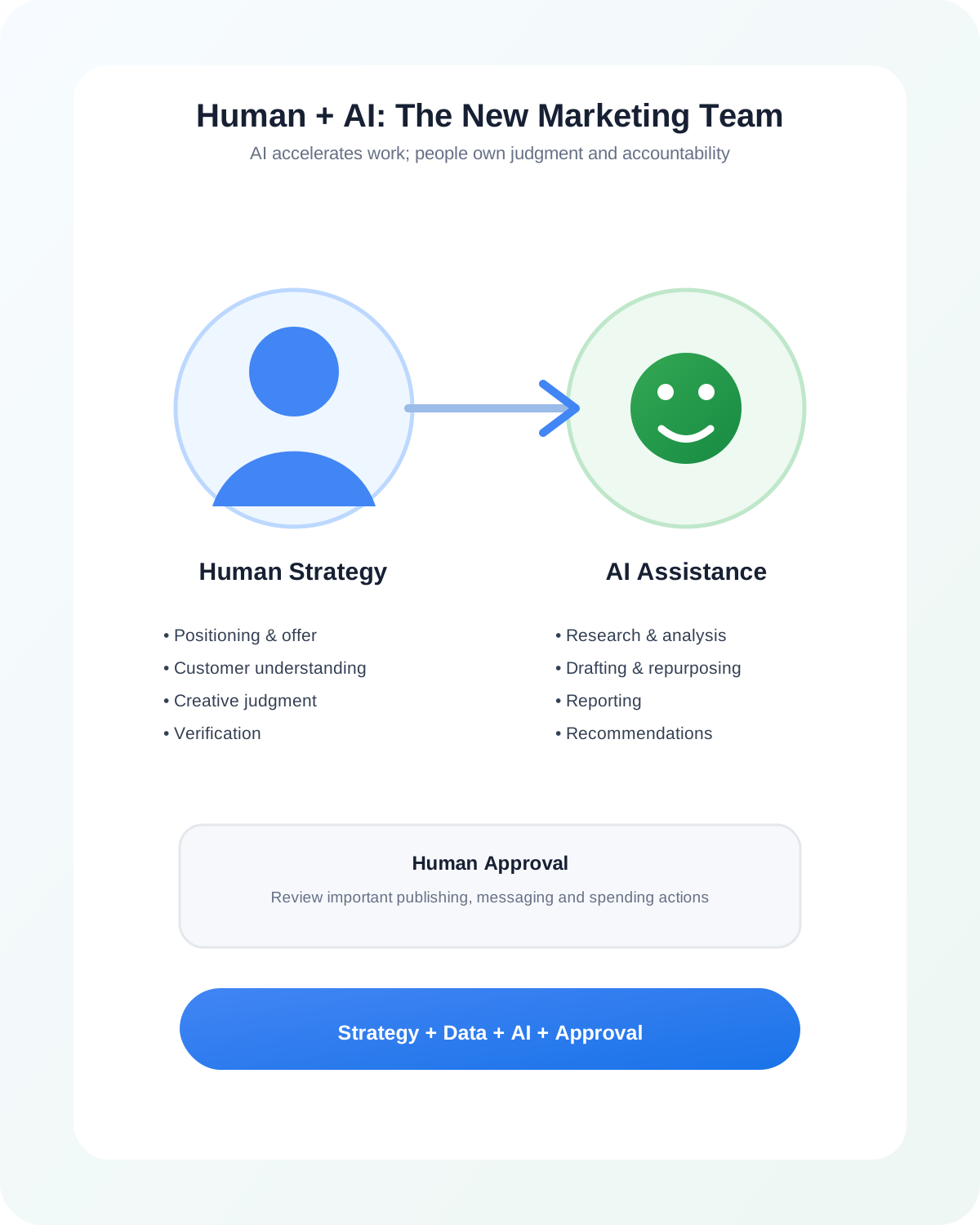
Human marketer and AI assistant working together on small business marketing

AI Agent vs Marketing Agency: Are They Competitors?

Not necessarily.

This is an important distinction.

An AI agent can help with:

Execution + analysis + repetitive work

A skilled marketer contributes:

Strategy + positioning + creative judgment + customer understanding + experimentation

For example, AI can produce:

"5 Instagram captions."

But a marketer should decide:

Which topic matters to this audience?

AI can analyze campaign data.

A marketer should ask:

Why are these leads poor quality?

AI can draft a landing page.

A marketer should decide:

Is this offer commercially compelling?

That distinction becomes more important as AI tools become more capable.

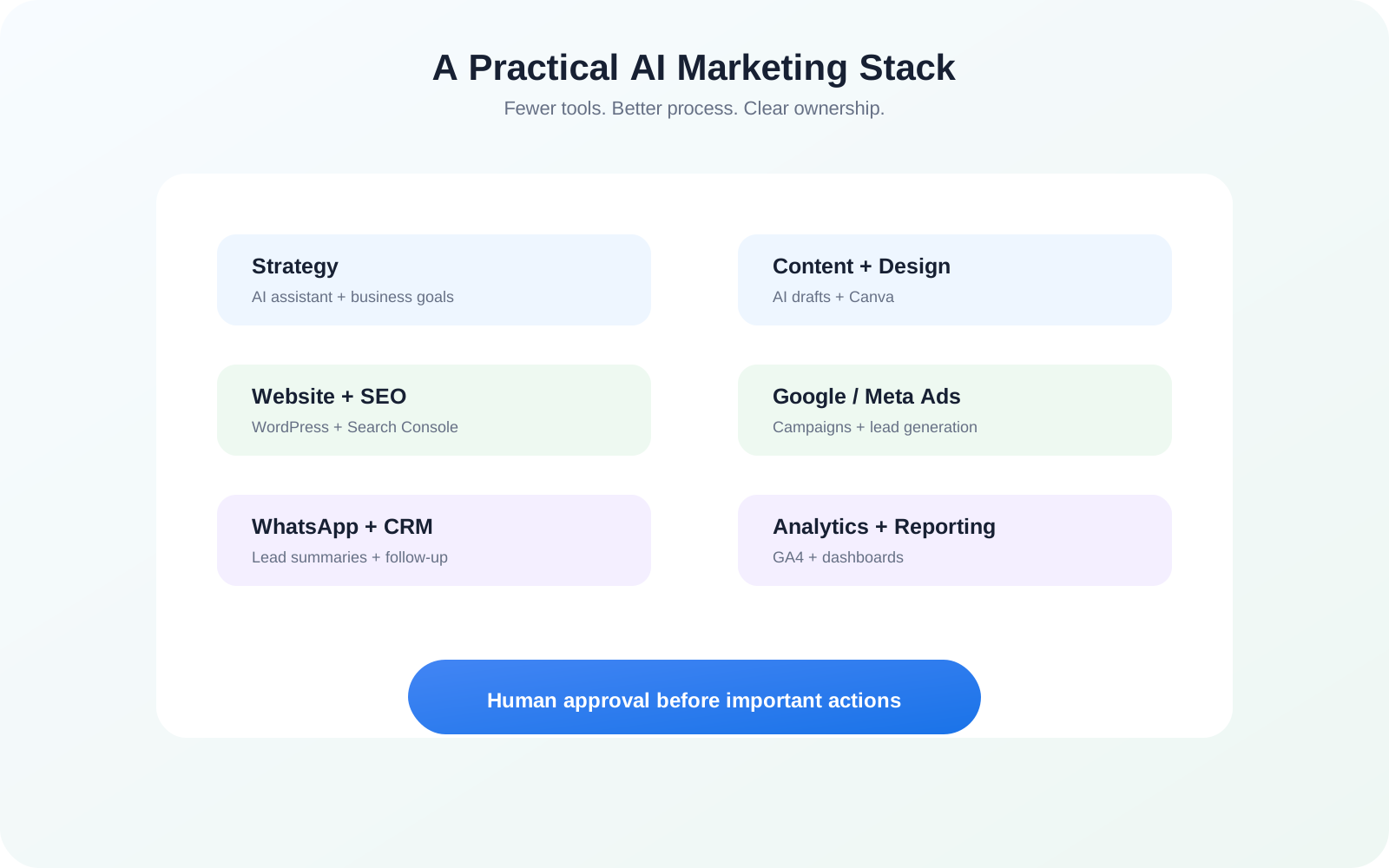
Practical AI marketing stack for small businesses

A Practical AI Marketing Stack for a Small Business

A small business doesn't need 30 AI tools.

A simpler system can be:

FunctionExample
StrategyAI assistant
DesignCanva
WebsiteWordPress
SEOGoogle Search Console + SEO tools
AdsMeta Ads / Google Ads
MessagingWhatsApp Business
CRMCRM platform
AnalyticsGA4
ContentAI + human editing
ReportingDashboard + AI summary

The goal should be:

Fewer tools + better process.

The Human Approval Rule

This is perhaps the most important rule for small businesses using AI agents:

Automate preparation before automating irreversible actions.

Good candidates for AI assistance:

  • Research
  • Analysis
  • Drafting
  • Summarization
  • Recommendations
  • Content variations
  • Reporting

Higher-risk actions should generally retain human approval:

  • Spending advertising budget
  • Publishing brand communications
  • Sending customer messages
  • Changing prices
  • Making financial decisions
  • Deleting data
  • Making contractual commitments

Meta specifically says Muse keeps the user in control and that nothing publishes, sends or spends without approval.

That is a useful principle beyond Muse itself.

What About Data Privacy?

AI agents can become more useful when they have access to more business information.

But that creates an obvious question:

What data are you connecting?

Before connecting tools, businesses should understand:

  • What information is shared
  • What permissions are granted
  • Who can access it
  • What actions the system can take
  • What approval controls exist
  • How sensitive customer information is handled

Don't connect every tool simply because you can.

Start with the minimum information required for the job.

Is Meta Muse Available in India?

This requires an important distinction.

Meta announced Muse for Small Business globally as a product expansion, but availability, integrations, pricing and access can vary by market.

Separately, Meta has already launched Business AI on WhatsApp for eligible small businesses in India, with support for customer questions, product recommendations, lead capture and appointment-related interactions. Meta says the feature is available in Indian languages and businesses remain able to take over conversations from the AI.

Therefore, Indian businesses should not assume every Muse capability announced in September is immediately available to every Indian account.

Check the actual availability for your account and market before planning a workflow around a specific feature.

What This Means for Digital Marketers

The skill set of a digital marketer is changing.

Old model:

Content Creator

New model:

AI-assisted Growth Operator

You increasingly need to understand:

  • SEO
  • Paid Ads
  • Content
  • Analytics
  • Automation
  • CRM
  • Customer journeys
  • AI agents
  • Conversion optimization

Not necessarily to perform every task manually.

But to understand how the pieces connect.

30-Day AI Marketing Implementation Plan

Week 1 — Audit

Document:

  • Marketing channels
  • Tools
  • Content workflow
  • Lead workflow
  • Ad workflow
  • Reporting process
  • Repetitive tasks

Find the tasks that consume the most time.

Week 2 — Build Your AI Workflow

Choose 3–5 repetitive tasks.

For example:

Task 1: Weekly social media performance summary

Task 2: Content repurposing

Task 3: Lead summary

Task 4: Ad performance analysis

Task 5: Blog-to-social transformation

Don't automate everything at once.

Week 3 — Connect Data Carefully

Connect only the tools you actually need.

For example:

Meta → Analytics → Content → Canva

or:

Website → Leads → CRM → Follow-up

Keep permissions controlled.

Week 4 — Measure

Compare:

### Before AI assistance

  • Time spent
  • Content produced
  • Reporting time
  • Lead response time

### After AI assistance

  • Time saved
  • Output quality
  • Errors
  • Human review time
  • Lead response
  • Marketing performance

The objective isn't:

"Use AI."

The objective is:

"Create a better business process."

10 Questions Every Small Business Should Ask Before Using an AI Agent

  1. What business problem are we solving?
  2. What task currently takes too much time?
  3. What data does the AI need?
  4. Is that data accurate?
  5. What permissions will the AI have?
  6. What actions require human approval?
  7. How will we measure success?
  8. What happens if the AI makes a mistake?
  9. Can a human take over?
  10. Does the workflow actually improve the customer experience?

If you can't answer these questions, don't automate yet.

The Future Isn't "AI vs Humans"

A more realistic future is:

Human Strategy

-

AI Assistance

-

Business Data

-

Automation

-

Human Approval

The competitive advantage won't necessarily belong to the business that uses the most AI tools.

It may belong to the business that builds the best system around them.

What Jalgaon Businesses Can Do Now

You don't need to wait for every AI feature to become available.

Start with the fundamentals.

### Step 1

Build a clear website.

### Step 2

Define your ideal customer.

### Step 3

Create a clear offer.

### Step 4

Set up reliable lead tracking.

### Step 5

Build a content system.

### Step 6

Use Google Ads and Meta Ads where appropriate.

### Step 7

Connect WhatsApp for conversations.

### Step 8

Use AI for repetitive work.

### Step 9

Keep humans responsible for important decisions.

### Step 10

Measure actual business outcomes.

Final Takeaway

Meta's announcement of Muse for Small Business on September 29, 2026 is another sign that AI is moving from a content-generation tool toward a broader business-operation layer.

For small businesses, the opportunity isn't simply:

"Let AI do marketing."

It is:

"Use AI to make the existing marketing system faster, more informed and more scalable."

A practical model is:

Strategy
↓
Website
↓
SEO / Local SEO
↓
Content
↓
Google Ads / Meta Ads
↓
Lead
↓
WhatsApp / CRM
↓
Sales
↓
Data
↓
AI-assisted analysis
↓
Better decisions

That's the direction small-business marketing is moving toward.

And businesses that learn how to combine human judgment + AI assistance + reliable data + strong digital foundations will be better prepared for what comes next.

Frequently Asked Questions

What is Meta Muse for Small Business?

Muse for Small Business is Meta's expanded AI-agent offering for small-business use. Meta says it can connect to business tools and accounts and work toward goals such as running a business or finding new customers.

Is Meta Muse the same as Meta Business AI?

No.

Meta Business AI on WhatsApp is a separate business-focused capability that Meta launched for eligible small businesses in India to help answer customer questions, recommend products, capture leads and support sales. Muse is a broader AI-agent product with integrations across business tools.

Can AI agents replace digital marketers?

Not completely.

They can automate or accelerate many repetitive tasks, but strategy, positioning, customer understanding, creative judgment, verification and business decisions still require human oversight.

Can AI agents run Meta Ads automatically?

Capabilities and permissions depend on the product, integration and account. Meta says Muse keeps users in control and does not publish, send or spend without approval.

Can Indian small businesses use AI for WhatsApp marketing?

Eligible Indian businesses can use Meta's Business AI on WhatsApp, which Meta says supports customer questions, recommendations, lead capture and appointment-related interactions. Availability depends on eligibility.

Should a small business connect all its tools to AI?

No.

Connect only the tools and data needed for the specific workflow. Review permissions and approval controls before connecting business information.

Will AI replace SEO?

No.

AI changes how marketers perform some SEO tasks, but useful content, crawlability, technical accessibility, internal linking, local relevance and user experience remain important.

Google's Search documentation continues to emphasize foundational SEO for modern Search experiences.

What is the best first AI automation for a small business?

Start with a repetitive, low-risk task such as:

  • Reporting
  • Content repurposing
  • Research organization
  • Lead summaries
  • FAQ drafting

Then measure the time saved and quality before expanding.

Can AI help generate leads?

AI can support lead-generation workflows, but lead generation still depends on the offer, audience, advertising, website, conversion process and sales follow-up.

AI is a tool inside the system, not the entire system.

Is AI marketing useful for local businesses in Jalgaon?

Yes, particularly for businesses that need to manage multiple channels with limited resources.

A practical local-business system can combine:

Local SEO + Website + Google Ads + Meta Ads + Content + WhatsApp + CRM + AI-assisted workflows.

Internal Linking Opportunities for Vidyaitech

1. Digital Marketing Services

Anchor: Digital Marketing Services in Jalgaon

URL:

https://vidyaitech.com/digital-marketing-services-in-jalgaon/

Suggested placement:

Businesses looking to combine SEO, paid advertising, social media and AI-assisted marketing can explore our Digital Marketing Services in Jalgaon.

2. Lead Generation

Anchor: Lead Generation Services in Jalgaon

URL:

https://vidyaitech.com/lead-generation-in-jalgaon/

Suggested placement:

AI can support the workflow, but businesses still need a reliable lead generation system to turn marketing activity into qualified enquiries.

3. Website Design

Anchor: website design and business growth

URL:

https://vidyaitech.com/why-website-design-matters-business-growth-in-2026/

Suggested placement:

AI cannot compensate for a confusing website, which is why website design and business growth should be addressed before adding automation.

4. About Vidyaitech

Anchor: learn more about Vidyaitech

URL:

https://vidyaitech.com/about-us/

5. Industries

Anchor: industries we serve

URL:

https://vidyaitech.com/Industries/

Explore Related Vidyaitech Services

TRUSTED RESOURCES

Recommended Reading

For platform-specific features and SEO fundamentals, refer to the original documentation and verify availability for your account and market.
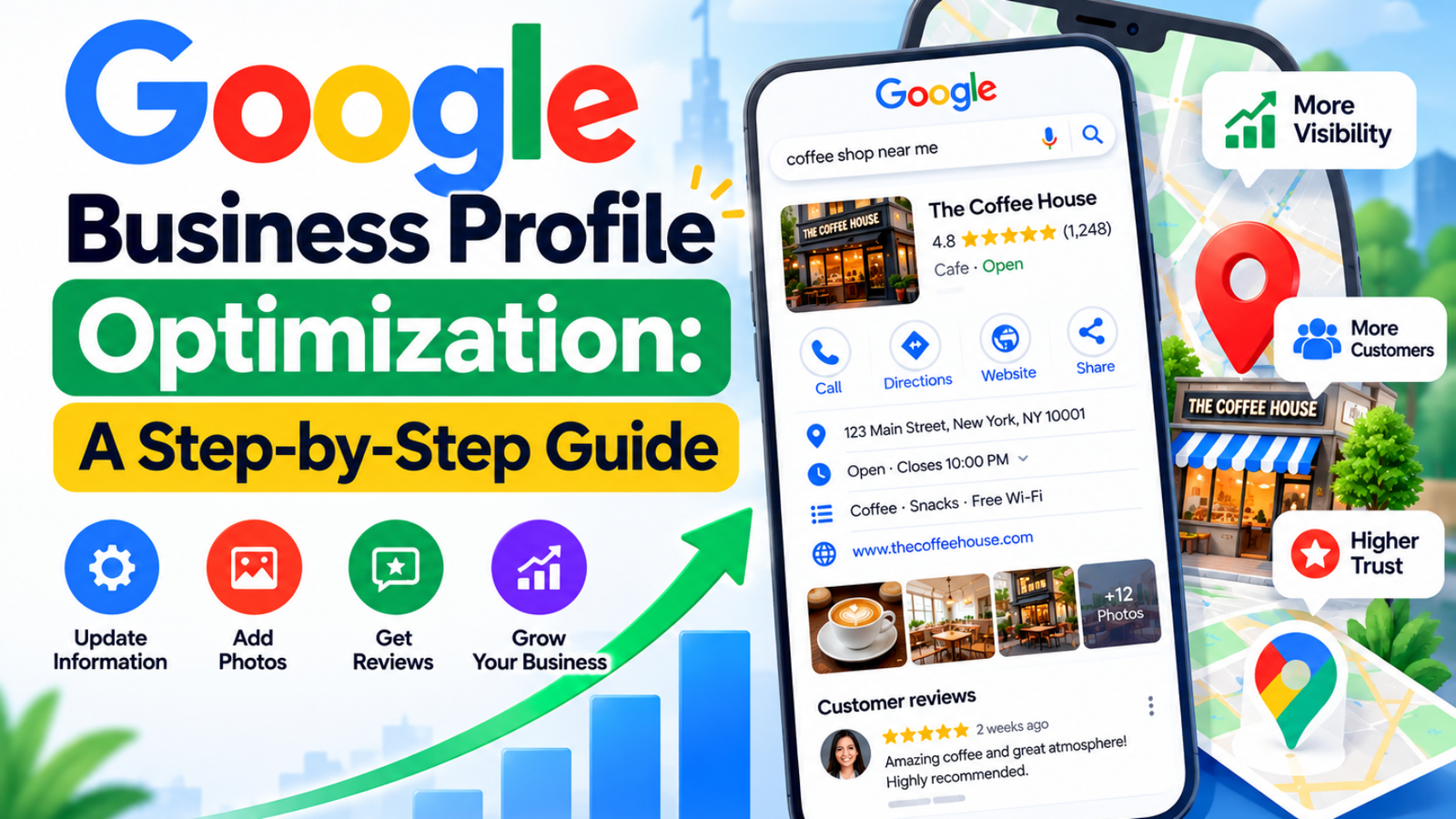
ChatGPT Image Sep 26, 2026, 04_09_14 AM

Google Business Profile Optimization: A Step-by-Step Guide

LOCAL SEO • 2026 GUIDE

Google Business Profile Optimization: A Step-by-Step Guide

Make your business easier for customers and search systems to understand, trust and contact with a practical Google Business Profile optimization process.

Updated for 2026 • Google Business Profile • Local SEO • AEO / GEO

Google Business Profile optimization showing a local business in Search and Maps

Google Business Profile optimization is the process of improving your business listing on Google Search and Google Maps so customers can find accurate information about your business and understand what you offer.

What Is Google Business Profile Optimization?

Google Business Profile (formerly Google My Business) helps businesses manage how their information appears across Google Search and Google Maps. A well-maintained profile can present your business name, category, services, hours, photos, reviews, contact details and other useful information.

Why Google Business Profile Optimization Matters for Local SEO

Improve Local Search Visibility

A complete, accurate profile gives Google clearer information about what your business is and the local searches it may be relevant to.

Help Customers Find Important Information

Keep your address, phone number, website, opening hours, services and directions accurate so customers can act without friction.

Build Trust Through Reviews and Photos

Authentic photos and genuine customer reviews provide real-world evidence about your business experience.

Generate Calls, Website Visits and Directions

Your profile can become a direct path from discovery to a call, website visit, direction request or other supported action.

Google Business Profile optimization checklist

How Google Local Rankings Work

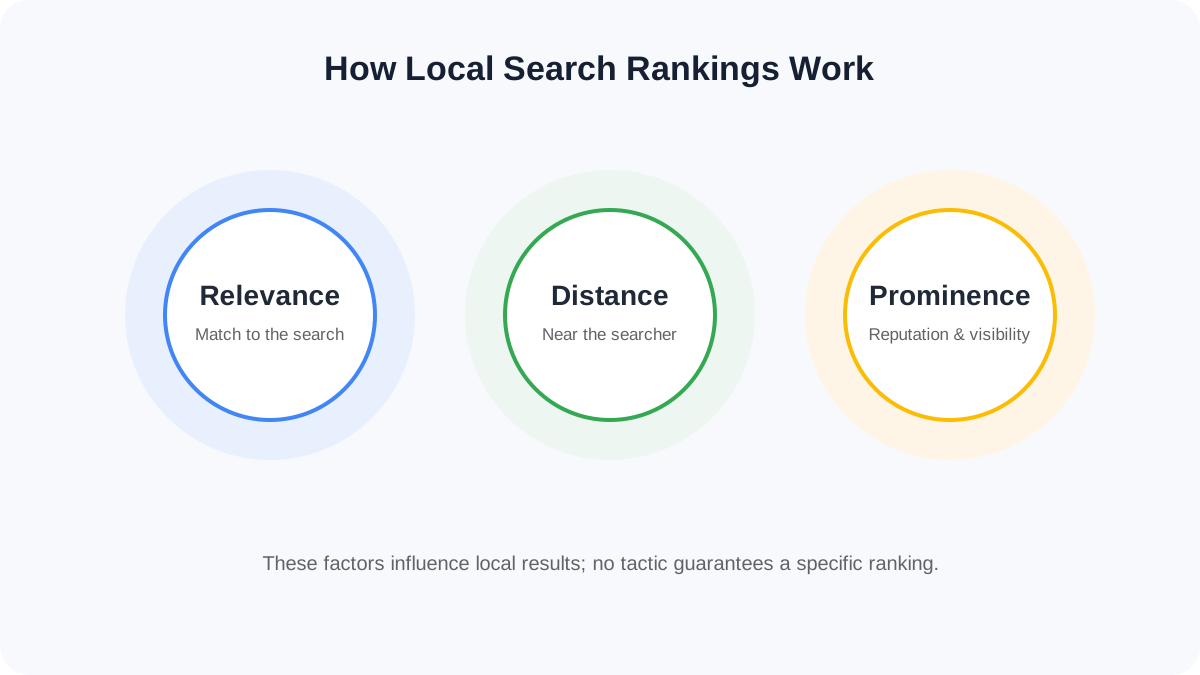
Google says local results are primarily based on relevance, distance and prominence. Businesses can improve the information and prominence signals they control, but they cannot directly change a searcher's physical distance from the business.

FactorWhat it meansWhat a business can do
RelevanceHow closely the profile matches the searchComplete accurate business information
DistanceHow far the business is from the searcherCannot directly control it
ProminenceHow well-known the business isBuild reputation, reviews and broader online presence
Local SEO ranking factors: relevance, distance and prominence

No legitimate optimization checklist can guarantee a #1 local ranking. The goal is to improve accuracy, relevance and the overall quality of your local presence.

Google Business Profile Optimization Checklist

Accurate business name
Right primary category
Complete hours & contact
Services & products
Authentic photos
Genuine reviews
Helpful updates
Consistent web information

Step-by-Step Google Business Profile Optimization

Step 1: Claim and Verify Your Profile

  1. Sign in with the appropriate Google Account.
  2. Find or create the profile.
  3. Claim an existing profile instead of creating a duplicate.
  4. Complete the verification process shown by Google.
  5. Keep the business information accurate.

Step 2: Choose the Right Primary Business Category

Select the most specific category that accurately represents what the business is. Do not use categories simply as a list of keywords.

Step 3: Complete Every Important Business Information Field

Use the real-world business name, accurate address or service area, authoritative phone number, official website, regular and special hours, and relevant factual attributes.

Step 4: Write a Helpful Business Description

Use a simple formula: Who you are + what you offer + who you serve + location + relevant differentiator.

Example for Vidyaitech:
Vidyaitech is a digital marketing and website development company serving businesses in Jalgaon and across Maharashtra. We provide website design, SEO, local SEO, Google Ads, Meta Ads, social media marketing and lead generation solutions for businesses looking to strengthen their online presence and generate qualified enquiries.

Step 5: Add Services and Products

List services that you genuinely provide, such as SEO, Local SEO, Google Ads, Meta Ads, social media marketing and lead generation. Avoid fake or irrelevant services created only to target keywords.

Step 6: Add Authentic Photos and Videos

Consider your logo, cover image, exterior, interior, team, products, services and real work/process photos. Authentic visuals are more useful than generic stock imagery for demonstrating the business.

Step 7: Build and Manage Customer Reviews

Ask genuine customers for reviews, make the process easy, respond professionally to positive and negative feedback, and never buy or manufacture reviews.

Step 8: Publish Useful Updates

Share new services, events, announcements, educational information, seasonal updates and appropriate offers. A useful pattern is Educate → Demonstrate → Inform → Occasionally promote.

Step 9: Connect GBP With Local SEO

Think of the ecosystem as GBP → Website → Local Content → Reviews → Citations → Brand Authority. Support it with useful service pages, location pages, consistent NAP information, internal links, relevant local content, appropriate local business schema and genuine local mentions.

Step 10: Keep Business Information Consistent

Keep your Name + Address + Phone consistent across your website, profile, social accounts, local directories, industry directories and other relevant sources.

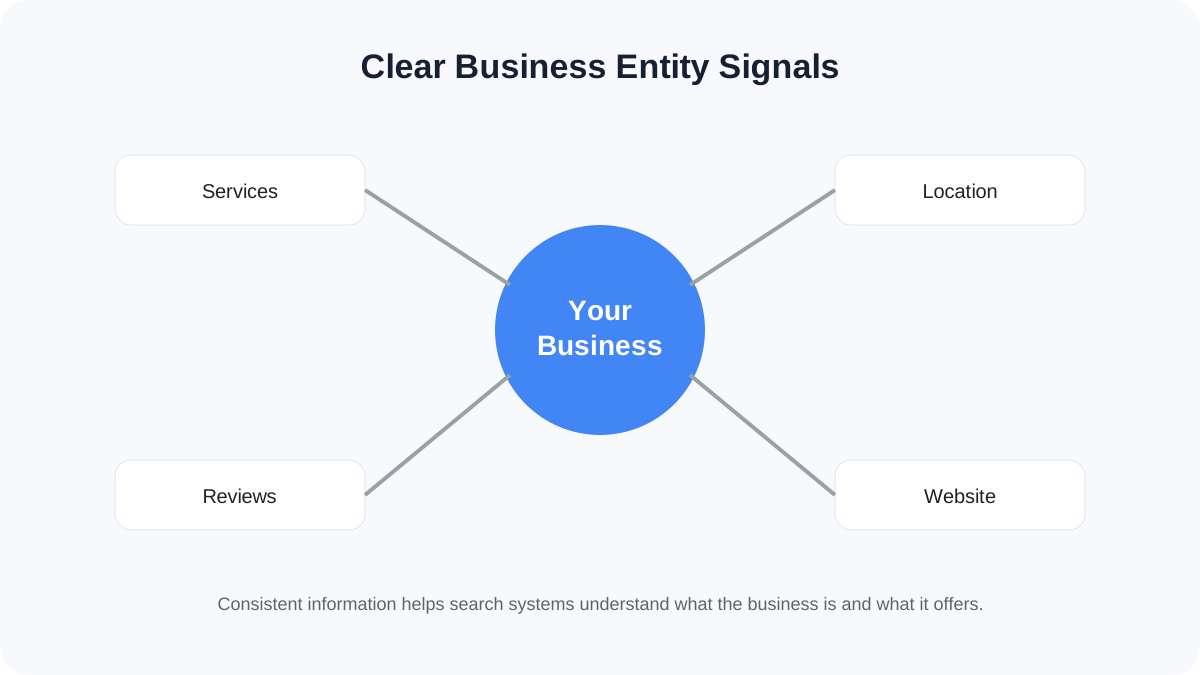
Google Business Profile and AI Search Visibility

Do not treat GBP optimization as a promise to “rank in ChatGPT.” Instead, build a clear and consistent digital information ecosystem so search systems can better understand the business, its services, location and reputation.

Business entity signals connecting services, location, reviews and website

For example, Vidyaitech can be understood through connected entities such as Digital Marketing → Website Development → SEO → Local SEO → Google Ads → Meta Ads → Jalgaon → Maharashtra → Small Businesses. That is more useful than repeating one keyword dozens of times.

Track Google Business Profile Performance

Depending on the profile and available reporting, performance information can include searches, views, calls, website clicks, directions, messages and bookings.

MetricWhat it tells you
SearchesHow people discover the profile
ViewsProfile visibility
CallsPhone-contact activity
Website clicksWebsite interest
DirectionsLocal visit intent
MessagesDirect enquiries
BookingsConversion activity where supported

Compare performance month to month rather than making decisions from a single day's data.

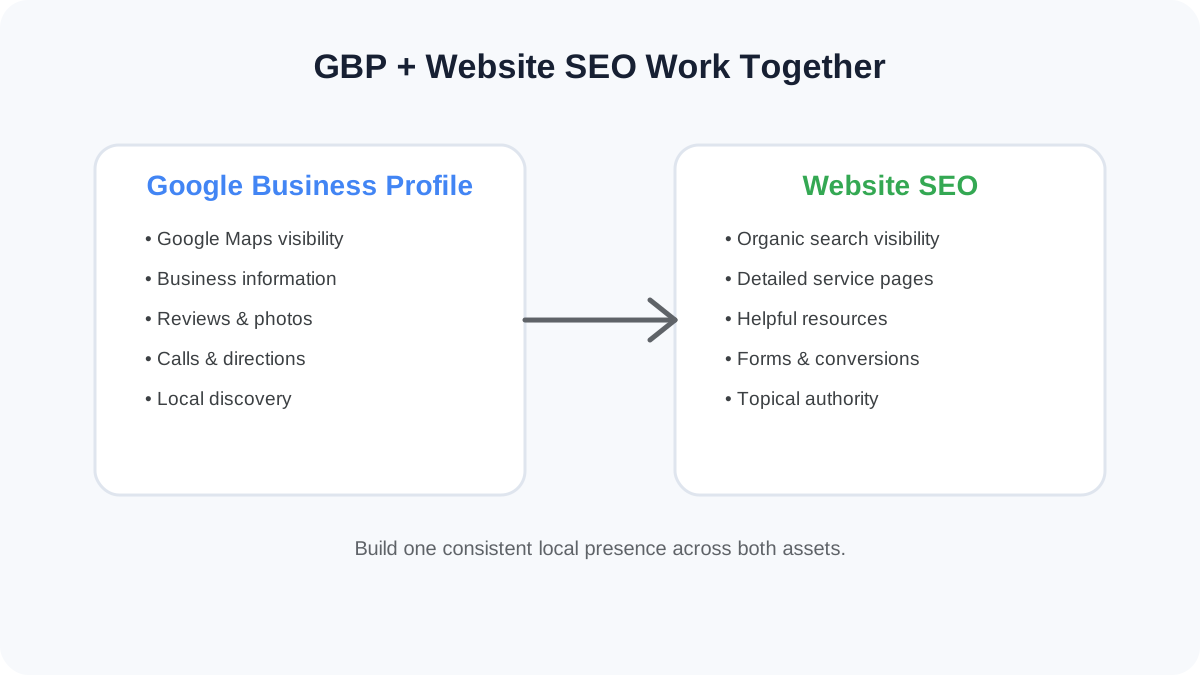
Google Business Profile vs Website SEO

Google Business ProfileWebsite SEO
Strong for local discoveryStrong for broader organic visibility
Google MapsOrganic search
Business informationDetailed content
ReviewsArticles and resources
Calls and directionsForms and conversions
Local presenceTopical authority
Google Business Profile and website SEO working together

Common Google Business Profile Mistakes to Avoid

  • Keyword-stuffing the business name
  • Choosing irrelevant categories
  • Creating duplicate profiles
  • Leaving important information incomplete
  • Ignoring reviews
  • Using only generic stock images
  • Showing incorrect opening hours
  • Inconsistent business information
  • Creating fake reviews
  • Treating GBP as a one-time setup

What Actually Works?

ActivityPurposeWhat to avoid
Accurate categoryRelevanceCategory stuffing
Complete informationBetter understandingMissing fields
Authentic photosTrustGeneric stock images
Genuine reviewsReputationPurchased reviews
Helpful responsesEngagementAutomated spam
Useful postsFresh informationConstant promotions
Website consistencyEntity clarityConflicting details
Performance trackingDecision-makingGuessing

30-Day Google Business Profile Optimization Plan

DaysActivity
1Audit existing profile
2Verify ownership
3Check business name
4Review primary category
5Review secondary categories
6Check address
7Check phone/website
8Update hours
9Review description
10Add services
11Add logo
12Update cover image
13Add exterior photos
14Add team photos
15Add service/product photos
16Review existing reviews
17Respond to unanswered reviews
18Create review-request process
19Review Q&A
20Create educational post
21Create service-focused post
22Create local post
23Check website consistency
24Check NAP citations
25Review local landing pages
26Check internal links
27Review search queries
28Check calls/website clicks
29Compare performance
30Create next-month optimization plan

FAQ: Google Business Profile Optimization

What is Google Business Profile optimization?

It is the process of improving a business listing with accurate information, relevant categories, services, photos, reviews and other useful details to strengthen its local search presence.

Is Google Business Profile free?

Creating and managing a Google Business Profile is generally free. Google also offers separate advertising products that businesses can pay for.

How do I optimize my Google Business Profile?

Start by verifying the profile, using the accurate business name and category, completing business information, adding services and authentic photos, managing reviews and monitoring performance.

Does Google Business Profile help local SEO?

Yes. Google states that Business Profiles can help businesses appear in local search results, and local results are primarily based on relevance, distance and prominence.

How important is the primary category?

The primary category helps Google understand what your business is. Choose the most specific category that accurately represents the core business.

Can I add keywords to my business name?

Not simply for SEO. The business name should reflect the real-world name of the business.

How often should I update my Google Business Profile?

Review important information regularly and update it whenever business details change. Add posts when there is something genuinely useful to communicate.

Why isn't my Google Business Profile ranking?

Possible factors include relevance, distance, prominence, profile completeness, category accuracy and the broader online presence of the business. There is no guaranteed formula for a specific ranking position.

Can Google Business Profile help with AI search?

A well-maintained profile contributes to the broader digital information ecosystem around a business. Clear, consistent information across the website and trusted sources can help search systems understand the business, although no GBP technique guarantees inclusion in an AI-generated answer.

Google Business Profile Optimization in 5 Points

  • Keep business information accurate and complete.
  • Choose the most relevant primary category.
  • Use authentic photos, services and genuine reviews.
  • Connect the profile with a consistent local SEO and website strategy.
  • Monitor performance and improve areas that generate meaningful customer actions.

Want to Improve Your Local Online Presence?

Vidyaitech helps businesses build stronger websites, Local SEO foundations and lead-generation systems for customers searching online.

Explore Vidyaitech Services
01-banner

WHY WEBSITE DESIGN MATTERS FOR BUSINESS GROWTH

Website Design & Growth

Why Website Design Matters for Business Growth in 2026

How a professional website helps businesses build trust, improve Google visibility and generate more leads.

Your website is often the first place a potential customer meets your business online.

Before calling you, sending an enquiry or buying from you, people may visit your website to understand:

  • What your business does
  • What services you provide
  • Whether you look professional
  • Whether they can trust you
  • How they can contact you

This is why website design is much more than colours, images and animations.

A good business website combines design, user experience, mobile responsiveness, SEO, speed, trust and conversion.

For businesses in Jalgaon and across India, a well-planned website can become an important part of a long-term digital marketing strategy.

At Vidyaitech, we believe a website should not simply look good. It should help a business get found, build trust and generate opportunities.

1.What Is Website Design?

Website design is the process of planning how a website looks, works and communicates with visitors.

It includes:

  • Layout
  • Colours
  • Typography
  • Images
  • Navigation
  • Buttons
  • Content structure
  • Mobile experience
  • User experience

But professional website design goes beyond appearance.

A good website should make it easy for visitors to understand your business and take the next step.

For example, a visitor should quickly understand: What do you offer? Who do you help? Why should they trust you? What should they do next?

That is where design becomes a business tool.

2.Your Website Creates the First Impression

Imagine a customer discovers your business through Google. They click your website. Within a few seconds, they form an opinion.

If the website looks outdated, confusing or difficult to use, they may leave — even if your actual products or services are excellent.

A professional website can create a stronger first impression through: clean design, clear information, professional branding, and easy navigation.

Your website should communicate the quality of your business before the customer ever speaks with you.

Illustration showing a Google search leading to a website, then to a trust badge, representing the first impression a website creates
Google Search → Website → First Impression → Trust

3.Good Design Builds Customer Trust

Trust is one of the biggest reasons people choose one business over another.

A website can build trust by showing:

  • Clear business information
  • Professional branding
  • Testimonials
  • Reviews
  • Portfolio or previous work
  • Contact information
  • Service details
  • Useful educational content
  • Real business photographs where appropriate

The goal is not to simply say "We are the best." Instead, your website should give visitors enough information to make that decision themselves.

Show your expertise. Don't just claim it.

4.Mobile-Friendly Design Is Essential

Many customers will visit your website using a smartphone. If your website works well on a desktop but looks broken on mobile, you can lose potential customers.

A responsive website should automatically adapt to: Mobile → Tablet → Laptop → Desktop

Important mobile considerations include:

  • Readable text
  • Easy navigation
  • Properly sized buttons
  • Fast loading
  • Simple forms
  • Images that fit the screen
  • Easy-to-use contact options

A good website should provide a smooth experience regardless of the device.

5.Simple Navigation Helps People Find Information

Imagine entering a shop where everything is randomly placed. You would probably leave. A website works in a similar way.

Visitors should be able to find important information without getting lost. A simple navigation structure might include:

Home | About | Services | Portfolio | Blog | Contact

Depending on the business, additional pages may be useful. The important principle is simple: don't make customers work to find what they need.

Good navigation improves user experience and helps visitors move naturally toward an enquiry or purchase.

6.A Website Should Help Generate Leads

A website isn't successful simply because people visit it. The bigger question is: what happens after someone visits?

If your goal is lead generation, your website should make contacting you easy. Useful calls to action can include:

  • Get a Quote
  • Book a Consultation
  • Request a Free Audit
  • Call Now
  • Send an Enquiry
  • WhatsApp Us

The CTA should be clear and relevant to the visitor. A good website guides people from: Visitor → Interest → Trust → Enquiry

Infographic showing the five-step journey from visitor to lead: visitor, understands, trusts, takes action, lead
How a website turns visitors into leads

7.Website Design and SEO Work Together

Beautiful design alone doesn't guarantee Google visibility. Your website also needs a strong SEO foundation. Important areas include:

  • Relevant keywords
  • Search-friendly page structure
  • Clear headings
  • Useful content
  • Internal linking
  • Descriptive image information
  • Mobile usability
  • Technical SEO
  • Fast performance
  • Crawlable pages

For example, a business targeting local customers might create useful pages around searches such as "Website Design Company in Jalgaon," "Web Development Company in Jalgaon," or "Digital Marketing Company in Jalgaon."

But keywords should be used naturally. Google's current guidance emphasizes creating useful content for people rather than producing pages primarily to manipulate rankings.

8.Website Speed Can Affect the User Experience

Nobody likes waiting for a website to load. Slow websites can create frustration and may cause visitors to leave before they see your offer.

A professional website should pay attention to: image optimization, efficient code, hosting performance, browser caching, mobile performance, unnecessary scripts, and page structure.

Speed is not about making every website look basic. It is about creating a balance between design, functionality and performance. A website should look professional without becoming unnecessarily heavy.

9.Content Is Part of Website Design

Website design and content should not be treated as separate things. A beautiful page with unclear content will still confuse visitors.

Your content should answer customer questions clearly. For example, instead of "We provide innovative digital solutions," say:

"We design websites and provide digital marketing services to help businesses improve their online visibility and generate leads."

The second statement tells the visitor exactly what the business does. Clear content also helps search engines better understand the purpose of your pages.

10.Local SEO Makes Your Website More Useful for Local Customers

If your business serves a particular city or region, local SEO should be part of your strategy. For example, a business serving Jalgaon may want to build visibility around relevant local searches.

Local SEO can involve:

  • Google Business Profile
  • Location-focused pages
  • Local search intent
  • Business information consistency
  • Reviews
  • Relevant local content
  • Local links and mentions

The goal isn't to repeat "Jalgaon" hundreds of times. The goal is to clearly communicate who you serve, what you offer, and where you operate.

11.Your Website Can Support AI Search and GEO

Search is changing. People increasingly use AI-powered search experiences to discover information. They may ask questions such as:

"How can a small business get more customers from Google?" or "What should I look for when choosing a website development company?"

This is where AI SEO, AEO and GEO become relevant. AEO means Answer Engine Optimization. GEO commonly refers to Generative Engine Optimization.

The practical approach is simple: create useful content that clearly answers real customer questions. For example — what is website development, how much does a business website cost, how long does website development take, why is SEO important, how does local SEO work, and how can a website generate leads.

Google's current guidance says websites don't need a special AI-only optimization system. Strong SEO fundamentals, useful content and clear site structure remain important for generative AI search experiences.

Infographic showing a website connected to Google Search and AI Search, with labels for useful content, local search, and trust
SEO is evolving — search is becoming more AI-driven

12.Useful Images Can Improve Understanding

Images shouldn't be added simply to fill empty space. A good image should help explain the topic. For example, a website development article could use website UI screenshots, before-and-after redesigns, mobile website examples, process diagrams, simple infographics, or service illustrations.

Google's current AI-search guidance also recommends useful, high-quality images and videos where they genuinely help users understand the content.

For Vidyaitech, this means our content should show how we think, not just tell people what services we offer.

13.Website Design and Web Development Must Work Together

Design creates the experience. Development makes that experience work. A professional website needs both.

Design focuses on visual appearance, UX, branding and layout. Development focuses on functionality, responsiveness, performance and technical structure.

When these work together, the result is a website that is beautiful, fast, functional, search-friendly and easy to use — that is the standard businesses should look for when choosing a web development partner.

14.Common Website Mistakes Businesses Should Avoid

Many businesses don't need a completely new website. Sometimes they need to fix a few important problems. Common mistakes include:

  • ✗ Confusing homepage headline
  • ✗ Difficult navigation
  • ✗ Poor mobile experience
  • ✗ Slow pages
  • ✗ Too much unnecessary text
  • ✗ No clear CTA
  • ✗ Missing trust signals
  • ✗ Outdated information
  • ✗ Weak SEO structure
  • ✗ No clear business objective

Before redesigning a website, ask: what is currently preventing visitors from becoming customers? That question can lead to a much better website strategy.

15.What Should a Business Website Include?

A professional business website may include:

HomepageClearly explain what the business offers.
AboutTell visitors who you are and why they should trust you.
ServicesExplain each service in simple language.
PortfolioShow your work, projects or examples.
TestimonialsShow genuine customer experiences where available.
BlogAnswer customer questions and demonstrate expertise.
ContactMake it easy for visitors to enquire.

The exact structure depends on the business. A restaurant, SaaS company, school and manufacturing company should not all use the same website structure. Your website should be designed around your customer and business goals.

Checklist graphic showing six essentials of a business website: clear message, mobile friendly, fast, SEO ready, trust signals, strong CTA
What should a business website have?

16.How Vidyaitech Approaches Website Design

At Vidyaitech, we don't see website development as simply creating pages. We look at the complete digital journey: Discover → Understand → Trust → Enquire → Convert

Our website design and development approach focuses on:

🌐 Modern Website Design
💻 Professional Web Development
📱 Responsive Mobile Experience
🔍 SEO-Friendly Structure
⚡ Performance & User Experience
🎯 Conversion-Focused Design
📈 Digital Marketing Integration
🤖 AI Search / GEO-Friendly Content

The goal is simple: build a website that works for your business — not just a website that looks good.

Whether you're launching a new business, redesigning an old website or trying to generate more enquiries, the right website can become the foundation of your digital marketing strategy.

Final Thoughts

Your website is often the bridge between online discovery and real business growth. A strong website can help your business build credibility, improve user experience, support SEO, reach local customers, answer customer questions, build trust, and generate enquiries.

But website design should never be treated as a one-time decoration project. Your website should continue to improve as your customers, market and digital search behaviour change.

And with Google Search increasingly incorporating AI-generated experiences, businesses should focus on what has always mattered most: create useful information, make your website easy to understand, give customers a reason to trust you, and make it easy to take action.

That is the foundation of a strong digital presence.

Vidyaitech closing brand visual — a website connected to website design, web development, SEO, digital marketing, lead generation, and AI search / GEO, with the message: build a website that works for your business

About Vidyaitech

Vidyaitech is a Website Design, Web Development and Digital Marketing company helping businesses build stronger online visibility and digital growth.

Website Design • Web Development • SEO • Digital Marketing • Lead Generation • Social Media Marketing • AI SEO & GEO

🌐 www.vidyaitech.com

Want to know what could be improved on your website? Comment “WEBSITE” or message Vidyaitech for a website review.
What is SEO A Complete Guide in 2026

What is SEO Full Guide In 2026

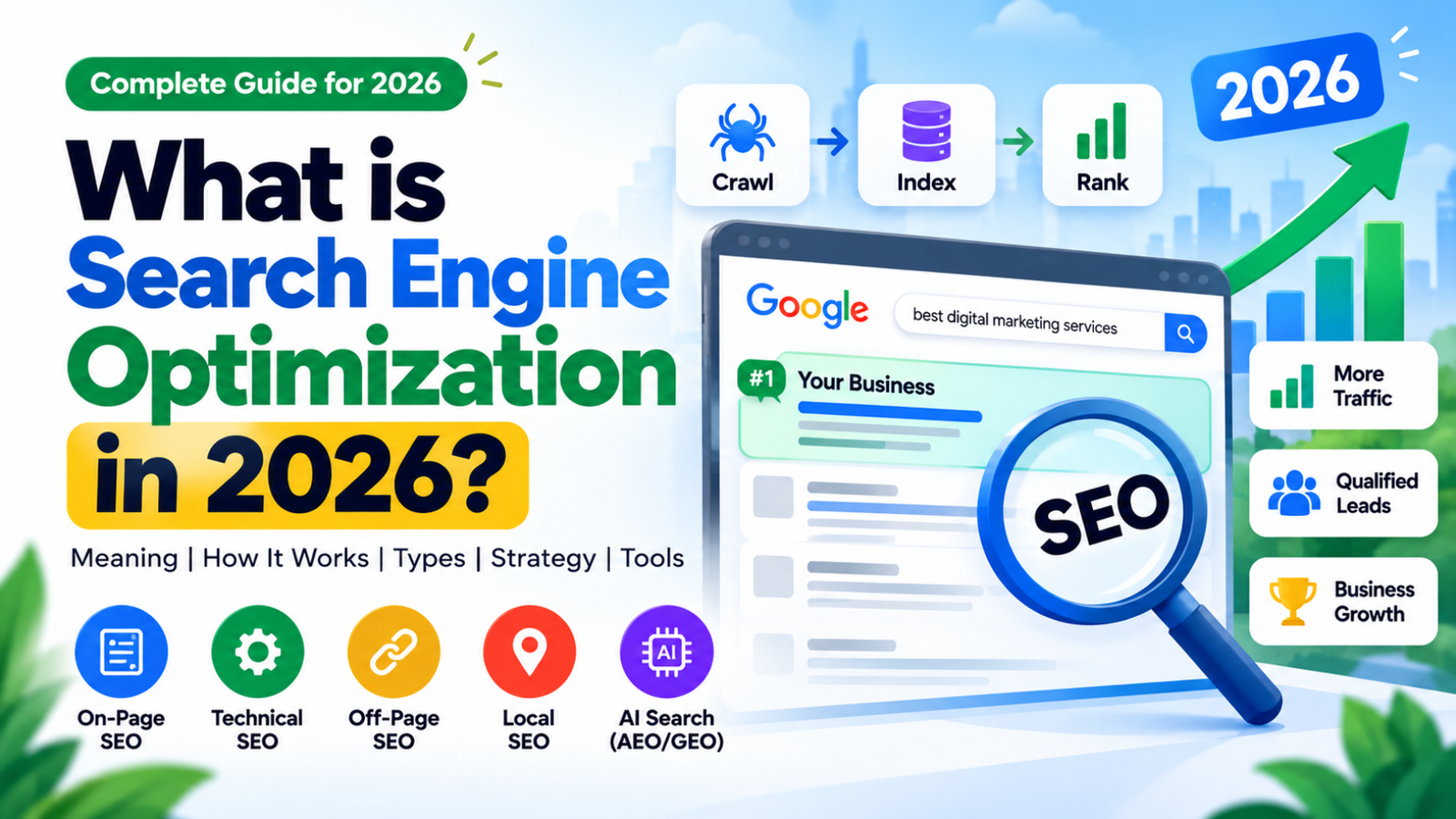
What Is SEO? Complete Search Engine Optimization Guide for 2026
SEO • COMPLETE 2026 GUIDE

What Is SEO? Complete Search Engine Optimization Guide for 2026

Learn what SEO means, how search engines work, the main types of SEO, keyword research, technical SEO, local SEO, AI search optimization, SEO tools, common mistakes and a practical SEO process.

Updated for 2026 • Search Engine Optimization • Local SEO • AEO / GEO
What Is SEO Complete Search Engine Optimization Guide for 2026

SEO stands for Search Engine Optimization. It is the process of improving a website's content, structure, technical performance, and authority so search engines can understand it and people can discover it through relevant organic searches.

In 2026, SEO is no longer only about ranking a webpage on Google. Search has expanded into AI-powered experiences, including Google's AI Overviews and AI Mode. However, the foundation remains the same: create useful, reliable, people-first content, make your website accessible to search engines, and provide a good experience for visitors. Google confirms that its existing SEO fundamentals continue to apply to its generative AI search experiences.

In simple words: SEO helps the right people find your website when they are searching for something your business, product, service, or content can provide.

This complete SEO guide explains what SEO means, how search engines work, the different types of SEO, keyword research, technical SEO, content, backlinks, local SEO, AI search optimization, SEO tools, common mistakes, measurement, and a practical SEO process for 2026.

---

What Is SEO?

Search Engine Optimization (SEO) is the practice of improving a website so that search engines can discover, understand, index, and potentially rank its pages for relevant searches.

SEO involves several connected areas:

  • Understanding what people search for
  • Matching content with search intent
  • Creating useful and original content
  • Optimizing page titles and headings
  • Improving internal linking
  • Making websites crawlable and indexable
  • Improving page experience and performance
  • Earning relevant mentions and links
  • Optimizing for local search
  • Measuring organic performance
  • Maintaining and improving content over time

The objective isn't simply to attract more visitors.

The real objective is to attract relevant visitors who have a reason to engage with your business or content.

For example, imagine a web design company in Jalgaon wants to reach local business owners.

Someone searches:

"Website Design Company in Jalgaon"

A well-optimized page that clearly explains the company's services, experience, process, location, examples, and contact options can become relevant to that search.

That is SEO in practice.

---

What Does SEO Mean in Digital Marketing?

SEO is one part of a larger digital marketing strategy.

Digital marketing can include:

  • SEO
  • Google Ads
  • Meta Ads
  • Social media marketing
  • Content marketing
  • Email marketing
  • Influencer marketing
  • Video marketing
  • Conversion rate optimization
  • Lead generation

The major difference is that SEO focuses on earning organic visibility rather than paying for every click.

For example:

Google Ads: You pay to show an advertisement for a search.

SEO: You optimize your website and content so it can earn visibility in organic search results.

SEO and paid advertising can work together. Paid campaigns can help businesses generate immediate visibility while SEO builds a longer-term organic asset.

---

Why Is SEO Important in 2026?

Having a website doesn't automatically mean people will find it.

A business may have:

  • A professional website
  • Good products
  • Excellent services
  • Strong customer reviews
  • Experienced employees

But if potential customers cannot discover the business during relevant searches, those assets may not generate enough opportunities.

SEO helps connect search demand with useful information and business solutions.

1. SEO can increase organic visibility

SEO helps search engines understand which pages are relevant to particular searches.

When relevant pages become visible, they can attract organic impressions and clicks.

2. SEO helps people discover businesses

People use search engines to research problems, compare businesses, evaluate products, find local services, and make purchases.

SEO helps businesses become discoverable during these journeys.

3. SEO can support qualified traffic

A visitor searching for:

"SEO services for small business"

has a different intent from someone randomly encountering an advertisement.

The first person has already expressed a specific need.

Good SEO connects content with that need.

4. SEO builds a reusable digital asset

A useful article, service page, resource, or category page can continue attracting search visibility after publication.

That doesn't mean SEO is passive or permanent. Search results change, competitors publish new content, and websites need maintenance.

5. SEO supports other marketing channels

SEO can work alongside:

  • Content marketing
  • Social media
  • Digital PR
  • Email marketing
  • Paid advertising
  • Local marketing
  • Lead generation

A strong SEO strategy can therefore become part of a broader digital growth system.

---

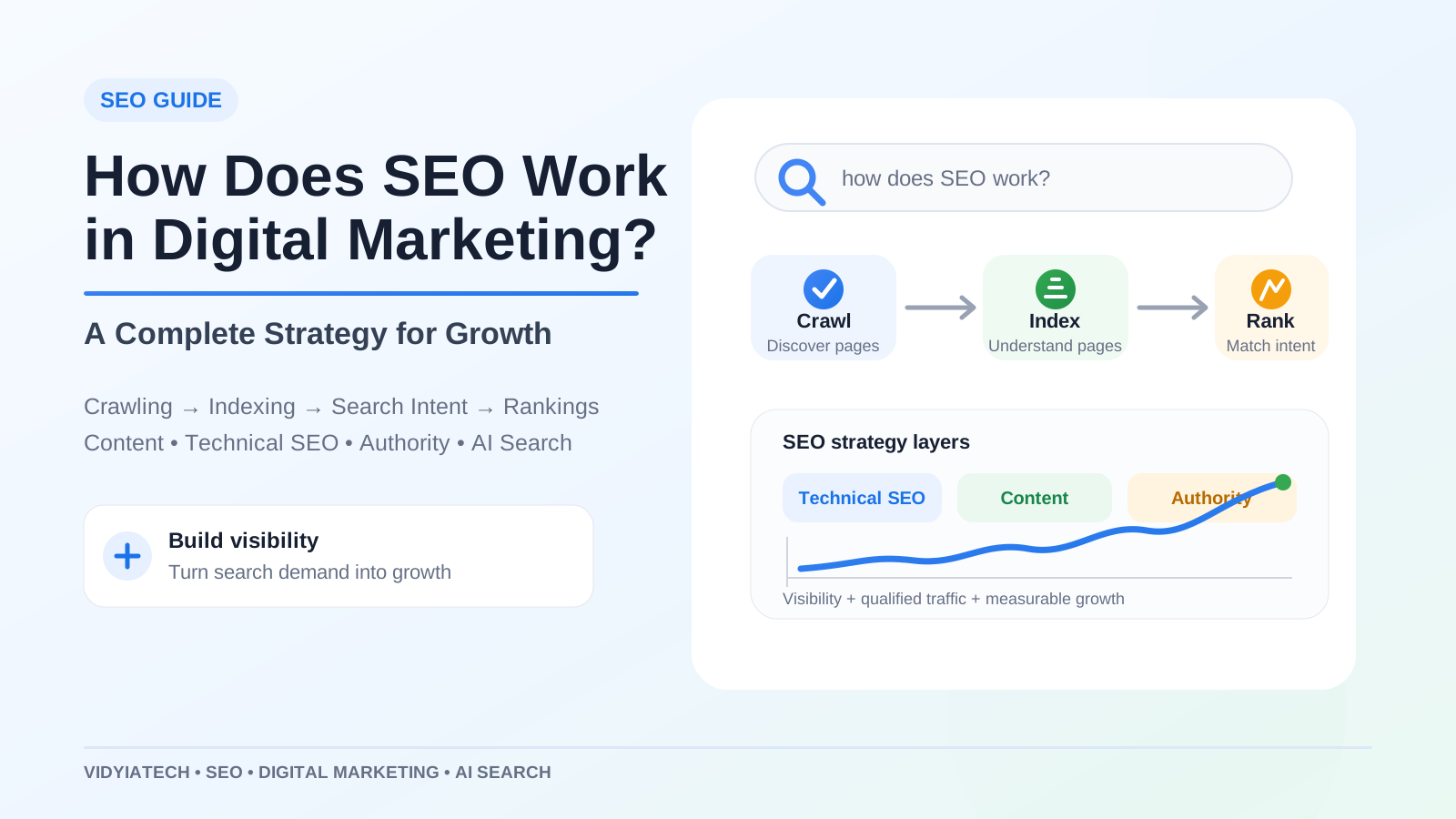
How Do Search Engines Work?

To understand SEO, you first need to understand the basic search process.

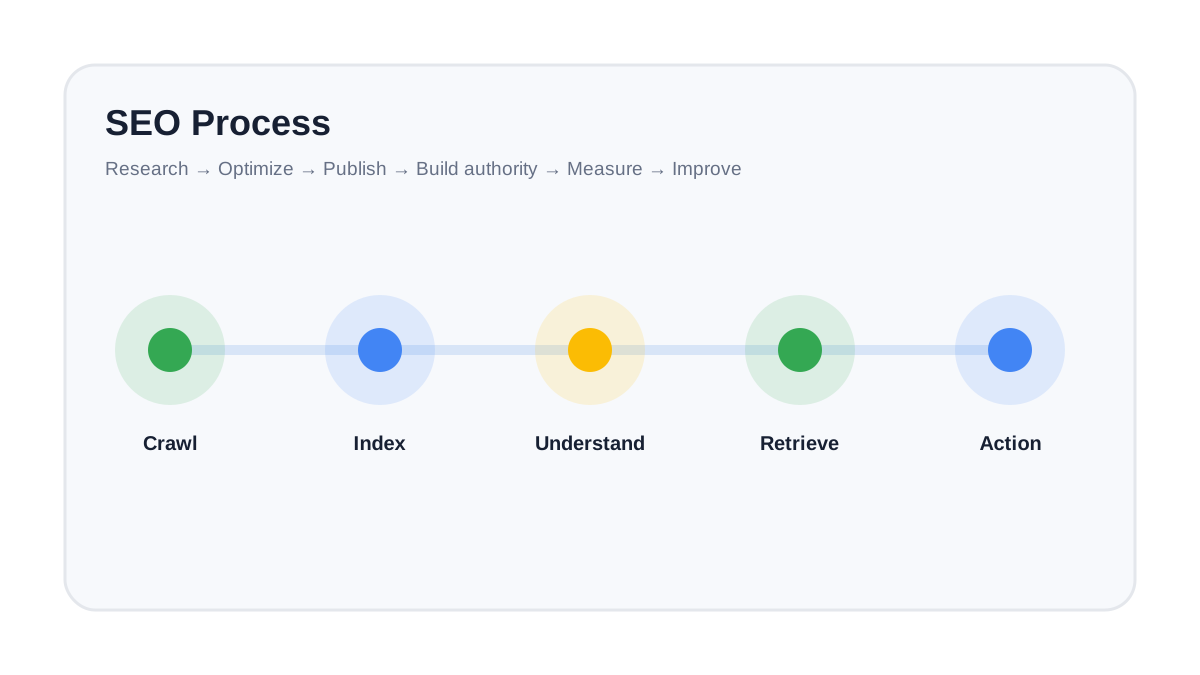
At a high level, search engines need to discover, understand, store, and retrieve web content.

1. Crawling

Search engines use automated systems to discover webpages.

These systems can follow links and find new or updated content.

If search engines cannot access a page, they may not be able to process it properly.

2. Indexing

After discovering a page, Google processes and understands its content and may store it in its search index.

Being indexed is important because an unindexed page generally cannot appear in Google's normal search results.

However, being indexed does not guarantee ranking.

3. Ranking

When someone searches, Google's systems determine which results are most relevant and useful for that particular query.

Many signals and systems contribute to this process.

This is why SEO is not simply:

Add a keyword → get a ranking.

Modern SEO involves relevance, quality, usefulness, technical accessibility, context, authority, user experience, and many other considerations.

Google's Search Essentials emphasize helpful, reliable, people-first content, crawlable links, appropriate use of words people search for, and following technical and spam guidelines.

---

The 5 Major Types of SEO

SEO isn't one single activity.

For a modern website, it is useful to think about SEO across five connected areas:

  1. On-Page SEO
  2. Technical SEO
  3. Off-Page SEO
  4. Local SEO
  5. AI Search Optimization / AEO / GEO

---

1. What Is On-Page SEO?

On-Page SEO involves optimizing the content and elements on individual webpages.

It includes:

  • Search intent
  • Keyword research
  • Page titles
  • H1/H2/H3 headings
  • Content quality
  • Internal links
  • URLs
  • Images
  • Alt text
  • Meta descriptions
  • Content structure
  • User experience

The objective is to make the page useful to people and understandable to search engines.

Example

Suppose you want to rank for:

"What is local SEO?"

A weak page might repeat "local SEO" dozens of times.

A stronger page would explain:

  • What local SEO means
  • Who needs it
  • How Google local search works
  • Google Business Profile
  • Reviews
  • Local citations
  • Local content
  • Local links
  • Common mistakes
  • Practical implementation

This is the difference between keyword targeting and topic satisfaction.

---

2. What Is Technical SEO?

Technical SEO focuses on the technical foundation that helps search engines access, crawl, understand, and process your website.

Important areas include:

  • Crawlability
  • Indexability
  • XML sitemap
  • Robots.txt
  • Canonical URLs
  • HTTPS
  • Mobile usability
  • Page performance
  • Core Web Vitals
  • JavaScript SEO
  • Redirects
  • Broken links
  • Structured data
  • Website architecture
  • Duplicate content

Technical SEO is particularly important because excellent content cannot perform properly if important pages are inaccessible, blocked, broken, or difficult to process.

Core Web Vitals

Google's Core Web Vitals measure real-world aspects of page experience:

  • LCP: Loading performance
  • INP: Responsiveness
  • CLS: Visual stability

Google recommends good Core Web Vitals as part of providing a strong user experience. Current guidance lists targets of approximately 2.5 seconds for LCP, under 200 milliseconds for INP, and under 0.1 for CLS for a good experience.

But don't make the mistake of treating a perfect PageSpeed score as the definition of SEO success.

Google explicitly notes that good Core Web Vitals alone do not guarantee top rankings.

---

3. What Is Off-Page SEO?

Off-Page SEO refers to activities and signals outside your own website that can contribute to your site's reputation and authority.

Common activities include:

  • Earning backlinks
  • Digital PR
  • Brand mentions
  • Industry relationships
  • Relevant business citations
  • Public relations
  • Useful guest contributions
  • Community participation

The key word is relevance.

The goal isn't to collect hundreds or thousands of random backlinks.

Instead, focus on earning genuine references from relevant and trustworthy sources.

What Is a Backlink?

A backlink is a link from another website to your website.

For example:

Industry publication → Your website

A relevant backlink can help people discover your content and can contribute to your site's overall authority signals.

But avoid manipulative link-building practices.

Google's current spam policies specifically identify practices such as buying links for ranking purposes, excessive link exchanges, automated link creation, low-quality directory links, and other forms of link spam.

---

4. What Is Local SEO?

Local SEO helps businesses become visible for searches connected to a location.

Examples include:

  • SEO company in Jalgaon
  • Digital marketing agency near me
  • Dentist in Pune
  • Restaurant in Mumbai
  • Website developer in Nashik

Local SEO commonly involves:

  • Google Business Profile
  • Local business information
  • Reviews
  • Location-focused content
  • Relevant local links and citations
  • Consistent business information
  • Location pages where genuinely useful

For local businesses, the website and Google Business Profile should support each other rather than operate as completely separate marketing assets.

---

5. What Is AI Search Optimization, AEO and GEO?

As search experiences evolve, people increasingly ask longer and more conversational questions.

This has led to terms such as:

  • AEO — Answer Engine Optimization
  • GEO — Generative Engine Optimization
  • AI SEO
  • AI Search Optimization

These terms are useful for describing the work involved in making information clear and understandable for AI-powered search experiences.

However, there is an important distinction:

Google does not say that websites need a special AI-only SEO system to appear in AI Overviews or AI Mode.

Google's current documentation says the same foundational SEO practices remain relevant. Pages need to be technically eligible for Search, indexed, crawlable, useful, and supported by strong content and page experience.

Therefore, instead of chasing an imaginary "AI ranking trick," focus on:

  • Clear answers
  • Accurate information
  • Strong topical coverage
  • Original insights
  • First-hand experience
  • Clear entities and terminology
  • Logical headings
  • Useful examples
  • Crawlable content
  • Internal linking
  • Trust signals

---

SEO vs AEO vs GEO: What's the Difference?

ApproachMain objective
SEOImprove organic search visibility
On-Page SEOImprove individual webpages
Technical SEOImprove crawlability, indexability and technical health
Off-Page SEOBuild reputation and authority
Local SEOImprove visibility for location-based searches
AEOStructure content to answer questions clearly
GEOOptimize content for generative/AI search experiences

These shouldn't be treated as completely independent marketing projects.

In practice, they overlap heavily.

A well-structured, useful and trustworthy SEO page can potentially serve users across traditional search and newer AI-powered search experiences.

---

How Does SEO Work?

A practical SEO workflow can be divided into these stages.

Step 1: Understand the Business

Before researching keywords, understand:

  • What the business sells
  • Who the customers are
  • Where the business operates
  • What makes the business different
  • Which products/services are most important
  • What customers need
  • What actions the website should generate

SEO without business context often becomes a list of keywords without commercial value.

---

Step 2: Research Search Intent

Search intent means understanding why someone performs a search.

Four common categories are:

Informational intent

The user wants information.

Example:

What is SEO?

Navigational intent

The user wants a specific website or brand.

Example:

Google Search Console

Commercial investigation

The user is researching before making a decision.

Example:

Best SEO agency for small business

Transactional intent

The user is ready to take action.

Example:

Hire SEO company in Jalgaon

Understanding intent helps you create the right page for the right query.

---

Step 3: Perform Keyword Research

Keyword research identifies the terms and questions your audience uses.

Useful tools include:

Free / accessible tools

  • Google Search Console
  • Google Keyword Planner
  • Google Trends
  • Google search suggestions
  • People Also Ask
  • Related searches

Professional tools

  • Semrush
  • Ahrefs
  • Ubersuggest
  • Screaming Frog
  • Keywords Everywhere

Your research should consider:

  • Search intent
  • Relevance
  • Competition
  • Search demand
  • Business value
  • Long-tail opportunities
  • Existing rankings
  • Competitor content

Don't choose keywords simply because they have high search volume.

A smaller keyword with strong commercial intent can sometimes be more valuable to a business than a huge informational keyword.

---

Step 4: Create Helpful Content

Once you understand the search intent, create content that genuinely solves the user's problem.

Google's current guidance emphasizes original, helpful, reliable, people-first content rather than content created primarily to manipulate search rankings.

For this reason, don't write an article simply because:

"This keyword has 10,000 searches."

Ask instead:

"Can we create something genuinely useful for the person searching this?"

Your content should ideally include:

  • A direct answer
  • Clear definitions
  • Practical examples
  • Step-by-step guidance
  • Relevant data where available
  • Original insights
  • Visual explanations
  • Internal links
  • External references
  • FAQs
  • Clear next steps

---

Step 5: Optimize the Page

Important on-page elements include:

SEO Title

Create a clear title that communicates what the page covers.

H1

Use one clear primary heading representing the main topic.

H2/H3 headings

Break the article into logical sections.

Meta description

Write a compelling description for search users.

Google may generate its own search snippet, so don't treat the meta description as a guaranteed SERP display.

URL

Keep the URL descriptive and understandable.

Images

Use useful images rather than decorative images added only to increase word count or page length.

Add descriptive alt text where appropriate.

Internal links

Link relevant concepts to deeper pages on your website.

Google's current AI-search documentation specifically recommends making important content discoverable through internal links.

---

Step 6: Improve Technical SEO

After content optimization, check the technical foundation.

Your SEO audit should include:

  • Indexability
  • Crawlability
  • XML sitemap
  • Robots.txt
  • HTTPS
  • Canonicals
  • Redirects
  • Broken links
  • Duplicate content
  • Mobile usability
  • JavaScript rendering
  • Page speed
  • Core Web Vitals
  • Structured data
  • Internal links

For larger websites, tools such as Screaming Frog can help identify technical problems at scale.

---

Step 7: Build Authority

Authority isn't created simply by publishing more articles.

You can build it through:

  • Original research
  • Case studies
  • Expert contributions
  • Digital PR
  • Industry mentions
  • Relevant backlinks
  • Useful resources
  • Genuine business partnerships
  • Demonstrable experience

For example, instead of publishing another generic article called:

"10 SEO Tips"

you could publish:

"Our Technical SEO Audit Checklist for Small Business Websites"

and document the actual process.

That gives the content more practical value.

---

Step 8: Measure Results

SEO should be measured using business and search data.

Important metrics include:

Search visibility

  • Impressions
  • Average position
  • Query visibility

Traffic

  • Organic sessions
  • Landing-page traffic
  • New users

Engagement

  • Engagement rate
  • Pages viewed
  • Returning users

Business outcomes

  • Leads
  • Calls
  • Form submissions
  • Sales
  • Revenue
  • Qualified enquiries

Google Search Console is especially useful for understanding queries, impressions, clicks and search performance. Google Analytics can then help you understand what visitors do after arriving on the website.

---

What Are the Most Important SEO Factors in 2026?

There is no single checklist that guarantees a first-place ranking.

Instead, think about SEO as a system.

1. Search intent

Does the page actually satisfy what the searcher wants?

2. Helpful content

Does the content solve the problem comprehensively?

3. Original value

Does the page add something beyond simply repeating other websites?

4. Experience and expertise

Does the content demonstrate real knowledge or first-hand experience?

5. Technical accessibility

Can search engines discover, crawl and process the page?

6. Internal linking

Can users and search engines discover related content easily?

7. Website experience

Is the website usable, readable, mobile-friendly and reasonably fast?

8. Reputation and authority

Does the website have credible external references and a trustworthy presence?

9. Local relevance

For local businesses, does the website accurately communicate the business, services and location?

10. Continuous improvement

Does the content remain accurate and useful as the topic changes?

Google's guidance consistently emphasizes usefulness, reliability, accessibility and strong page experience rather than a single ranking trick.

---

What Is E-E-A-T in SEO?

E-E-A-T stands for:

  • Experience
  • Expertise
  • Authoritativeness
  • Trustworthiness

It is useful to think of E-E-A-T as a framework for creating credible content rather than a simple "ranking score."

Experience

Can the writer demonstrate first-hand experience?

For example:

  • A case study
  • Screenshots
  • Implementation details
  • Real examples
  • Lessons learned

Expertise

Does the author understand the subject?

Authoritativeness

Is the author or website recognized as a useful source in its field?

Trustworthiness

Is the information accurate, transparent, and supported appropriately?

For a business website, practical experience can be particularly valuable.

Instead of saying:

"SEO is very important."

show readers:

"Here is the SEO audit process we use, what we check, what problems we commonly find, and how we prioritize fixes."

That is much stronger evidence of experience.

---

Does AI-Generated Content Work for SEO?

AI can be useful for:

  • Research
  • Brainstorming
  • Content outlines
  • Keyword clustering
  • Summarizing information
  • Drafting
  • Editing
  • Data organization

But publishing large volumes of unedited, low-value AI-generated content simply to obtain rankings creates risk.

Google's guidance says generative AI can be useful when it helps create original, valuable content, but generating many pages without adding value can fall under scaled content abuse.

A better workflow is:

Research → AI assistance → Human expertise → Fact-checking → Original examples → Editing → Optimization → Publication → Measurement

AI should accelerate the workflow.

It shouldn't replace expertise.

---

How to Optimize Content for AI Search in 2026

Instead of trying to "hack" AI search, make your content easy to understand and verify.

Start sections with direct answers

For example:

What is Technical SEO?

Technical SEO is the process of improving the technical foundation of a website so search engines can crawl, understand and index its pages effectively.

Then explain the topic in greater depth.

Use descriptive headings

Use:

What Is Local SEO?

instead of:

Why This Matters

Use specific examples

Specific examples are easier to understand than generic marketing statements.

Support important claims

Use authoritative sources for factual claims.

Demonstrate experience

Add:

  • Case studies
  • Screenshots
  • Original research
  • Examples
  • Processes
  • Lessons learned

Build topical depth

Instead of creating 20 thin articles about SEO, create a strong SEO topic cluster covering:

SEO → On-Page SEO → Technical SEO → Local SEO → Keyword Research → Content SEO → Link Building → SEO Audit → AI Search

Google's current generative-search guidance reinforces the importance of valuable, unique content and the continued relevance of established SEO fundamentals.

---

What Is Local SEO and Why Does It Matter for Small Businesses?

For businesses serving specific locations, local SEO can be especially important.

For example, a business in Jalgaon may target searches such as:

  • Digital Marketing Services in Jalgaon
  • SEO Services in Jalgaon
  • Website Design Company in Jalgaon
  • Local SEO Services
  • Digital Marketing Agency Near Me

A local SEO strategy can include:

  1. Google Business Profile optimization
  2. Location-relevant website content
  3. Local service pages
  4. Reviews
  5. Consistent business information
  6. Local citations
  7. Relevant local links
  8. Local content
  9. Mobile-friendly website experience

However, avoid creating dozens of nearly identical city pages just to capture search variations.

Google's spam policies specifically warn against doorway pages and substantially similar pages created primarily to capture search queries.

---

SEO Tools Every Beginner Should Know

You don't need every SEO tool available.

Start with a practical toolkit.

ToolMain use
Google Search ConsoleSearch performance and indexing
Google Analytics 4Traffic and user behaviour
Google Keyword PlannerKeyword research
Google TrendsSearch interest and trends
PageSpeed InsightsPerformance analysis
Screaming FrogTechnical SEO crawling
AhrefsKeywords, backlinks and competitors
SemrushSEO research and competitive analysis
UbersuggestKeyword and competitor research
AnswerThePublicQuestion/topic research

A beginner should learn how to interpret the data, not simply collect reports.

---

Common SEO Mistakes to Avoid in 2026

1. Keyword stuffing

Repeating the same keyword unnaturally doesn't create better SEO.

Google specifically identifies keyword stuffing as spam.

2. Publishing generic AI content at scale

More pages do not automatically mean more visibility.

3. Buying spammy backlinks

Cheap backlink packages can create unnecessary risk.

4. Ignoring technical SEO

A great article is not useful if important pages cannot be crawled or indexed.

5. Writing without search intent

A page can target the right keyword and still fail because it doesn't satisfy the searcher's actual need.

6. Creating thin location pages

Don't create dozens of pages that simply replace one city name with another.

7. Focusing only on rankings

Ranking is useful, but the business outcome matters more.

Ask:

Did the traffic produce qualified enquiries?

8. Never updating content

Facts, competitors, products, search behaviour and Google's systems change.

9. Over-optimizing for AI

There is no magic AI schema that guarantees inclusion.

Google says its existing SEO fundamentals remain the foundation for AI search experiences.

10. Promising guaranteed rankings

No legitimate SEO strategy can guarantee a specific Google position.

---

How Long Does SEO Take to Work?

There is no universal SEO timeline.

Results depend on:

  • Website age
  • Existing authority
  • Competition
  • Search intent
  • Industry
  • Content quality
  • Technical condition
  • Backlink profile
  • Location
  • Search demand
  • Implementation consistency

A new local business targeting a low-competition niche may see movement sooner than a national website targeting a highly competitive keyword.

Therefore, avoid promises such as:

"Rank #1 in 30 days."

A better approach is to establish measurable milestones:

Month 1: Audit, technical fixes, keyword research and strategy.

Months 2–3: On-page improvements, content and internal linking.

Months 3–6: Content expansion, authority development and optimization.

6+ months: Scale what is working, improve existing pages and expand topical coverage.

These are planning ranges, not guarantees.

---

A Practical SEO Strategy for a New Website

If you are starting SEO from zero, follow this sequence.

Step 1: Set up measurement

Configure:

  • Google Search Console
  • Google Analytics
  • Conversion tracking

Step 2: Audit the website

Check:

  • Indexing
  • Crawlability
  • Mobile usability
  • Speed
  • Broken links
  • Metadata
  • Content
  • Internal links

Step 3: Define your customers

Identify:

  • Who they are
  • What they need
  • What they search
  • Where they are located
  • What makes them choose a provider

Step 4: Perform keyword research

Build a keyword map based on intent.

Step 5: Fix important pages first

Prioritize:

  • Homepage
  • Core service pages
  • Product/category pages
  • Location pages
  • High-potential existing articles

Step 6: Build topical content

Create supporting articles that answer customer questions.

Step 7: Improve internal linking

Connect related pages using descriptive anchor text.

Step 8: Earn relevant authority

Use:

  • Digital PR
  • Industry relationships
  • Useful resources
  • Relevant citations
  • Genuine outreach

Step 9: Improve conversion

Don't stop at traffic.

Improve:

  • CTAs
  • Contact forms
  • WhatsApp
  • Phone visibility
  • Landing pages
  • Trust signals

Step 10: Measure and improve

Every month ask:

  • What gained visibility?
  • What lost visibility?
  • Which pages generate traffic?
  • Which queries are growing?
  • Which pages generate leads?
  • What should be improved next?

---

SEO for a Local Business: Example

Imagine a web design and digital marketing business serving Jalgaon.

A basic strategy could look like this:

Core service pages

  • Website Design
  • SEO
  • Local SEO
  • Digital Marketing
  • Google Ads
  • Meta Ads
  • Lead Generation

Local intent

  • Website Design Company in Jalgaon
  • Digital Marketing Services in Jalgaon
  • SEO Services in Jalgaon
  • Local SEO Services in Jalgaon

Supporting content

  • What Is SEO?
  • How Does SEO Work?
  • How Much Does SEO Cost?
  • What Is Local SEO?
  • Google Business Profile Optimization Guide
  • SEO Checklist for Small Businesses
  • How to Improve Google Maps Visibility

Conversion layer

Every important page should help visitors understand:

What you do → Who you help → Why it matters → How you work → Evidence → What to do next

This creates a connection between SEO and lead generation.

---

SEO vs Google Ads: Which Should You Use?

SEO and Google Ads solve different problems.

SEOGoogle Ads
Organic visibilityPaid visibility
Long-term investmentImmediate campaign visibility
Requires content and optimizationRequires advertising budget
Can compound over timeTraffic generally depends on active campaigns
Strong for informational and commercial searchesStrong for high-intent paid search
Requires patienceCan generate traffic quickly

For many businesses, the practical answer isn't necessarily SEO or Ads.

A business can use paid search for immediate demand capture while building organic visibility through SEO.

---

How to Measure SEO Success

Don't judge SEO using rankings alone.

Use a complete measurement framework.

Visibility

  • Impressions
  • Queries
  • Average position
  • Search visibility

Traffic

  • Organic sessions
  • Landing pages
  • New users

Engagement

  • Engagement rate
  • Page views
  • Returning visitors

Leads

  • Contact forms
  • Calls
  • WhatsApp enquiries
  • Consultation requests

Revenue

  • Sales
  • Customer acquisition
  • Revenue from organic traffic

The ultimate question should be:

Is SEO helping the business attract relevant customers and achieve its goals?

---

The Future of SEO in 2026 and Beyond

SEO is changing, but the fundamentals aren't disappearing.

Search is becoming:

  • More conversational
  • More visual
  • More personalized
  • More AI-assisted
  • More multi-modal

At the same time, users still need:

  • Accurate information
  • Useful websites
  • Trusted businesses
  • Good products
  • Clear answers
  • Fast experiences
  • Evidence

Google's 2026 guidance on generative AI search reinforces this point: existing SEO fundamentals remain foundational, and there is no separate set of secret requirements for AI Overviews or AI Mode.

The future of SEO is therefore not:

SEO vs AI

It is:

SEO + useful content + technical accessibility + expertise + trust + strong user experience.

---

Frequently Asked Questions About SEO

What does SEO stand for?

SEO stands for Search Engine Optimization. It is the practice of improving a website so search engines can understand its content and users can discover it through relevant organic searches.

What is SEO in digital marketing?

SEO is the organic search component of digital marketing. It helps businesses attract relevant visitors from search engines without paying for every individual organic click.

How does SEO work?

SEO works by improving a website's relevance, content, technical accessibility, user experience and authority so search engines can better understand and evaluate its pages for relevant searches.

What are the main types of SEO?

The main areas include On-Page SEO, Technical SEO, Off-Page SEO, Local SEO, and AI Search Optimization/AEO/GEO.

Is SEO still important in 2026?

Yes. Search is evolving through AI-powered experiences, but Google continues to recommend foundational SEO practices such as crawlability, useful content, internal linking, structured content, and good page experience.

Is SEO free?

Organic search traffic doesn't require paying Google for each click, but SEO requires investment in strategy, content, technical work, tools, expertise and ongoing maintenance.

Can I do SEO myself?

Yes. Beginners can learn and implement many SEO fundamentals themselves. More complex websites or competitive markets may require specialist knowledge and tools.

How long does SEO take?

There is no fixed timeline. Results depend on competition, website authority, technical condition, content quality, search intent and consistency.

Does SEO work for small businesses?

Yes. Small businesses can use SEO to target relevant local, niche, service-based and long-tail searches. Local SEO can be particularly important for businesses serving a defined geographic market.

Do backlinks still matter?

Relevant, trustworthy backlinks can contribute to a website's authority, but the objective should be earning legitimate references rather than buying or generating manipulative links.

What is AEO?

AEO, or Answer Engine Optimization, generally refers to structuring content so it can clearly answer questions in answer-oriented search experiences.

What is GEO?

GEO commonly refers to Generative Engine Optimization, the practice of preparing content for generative AI search experiences.

Does Google require special AI SEO?

No. Google's current documentation says there are no additional technical requirements or special AI-only optimizations required for eligibility in AI Overviews or AI Mode. Existing SEO fundamentals remain important.

---

AI-Readable Summary: What Is SEO?

  • SEO means Search Engine Optimization—the process of improving a website so search engines can understand it and users can discover it through relevant organic searches.
  • Modern SEO includes content, technical SEO, on-page optimization, authority, local SEO, user experience and search intent.
  • In 2026, AI-powered search adds new discovery surfaces, but Google's guidance says traditional SEO fundamentals remain the foundation.
  • Successful SEO focuses on useful, trustworthy, original content rather than keyword stuffing or ranking manipulation.
  • SEO should ultimately be measured by meaningful outcomes such as qualified traffic, enquiries, conversions and business growth—not rankings alone.

---

Final Thoughts: What SEO Really Means in 2026

SEO has moved far beyond simply placing keywords inside a webpage.

Modern SEO is about helping search systems and people understand:

Who you are → What you offer → Who you help → Why your information is useful → Why your business can be trusted.

The strongest SEO strategy combines:

Search Intent + Useful Content + Technical SEO + Internal Linking + Authority + Local Relevance + User Experience + Measurement

And as AI-powered search develops, businesses should resist the temptation to chase shortcuts.

Instead, build a website that deserves to be found.

Create original content.

Show real experience.

Answer customer questions.

Keep important information accurate.

Make your website technically accessible.

Earn genuine references.

Measure what actually contributes to business growth.

That is the foundation of SEO in 2026—and it is much more sustainable than trying to find the next ranking trick.

---

About Vidyaitech

Vidyaitech helps businesses build stronger digital visibility through website design, SEO, local SEO, AI search optimization, digital marketing and lead generation.

Our approach combines strategy, website experience, search visibility, content and performance marketing rather than treating each activity as an isolated task.

If your website receives traffic but isn't generating enough enquiries, the next step isn't always "more traffic."

Sometimes the better question is:

Is the right audience finding the right page—and does that page give them a reason to take action?

That is where SEO and conversion-focused digital marketing need to work together.

Need Help Improving Your Website's SEO?

Vidyaitech helps businesses with website design, SEO, local SEO, AI search optimization, digital marketing and lead generation.

Explore Vidyaitech Services
© 2026 Vidyaitech • Website Design • SEO • Local SEO • Digital Marketing

How Does SEO Work in Digital Marketing? A Complete Strategy for Growth

VIDYAITECH · SEO · DIGITAL MARKETING

How Does SEO Work in Digital Marketing? A Complete Strategy for Growth

Understand how SEO connects search intent, content, technical accessibility, authority and user experience to build sustainable organic visibility, relevant traffic and business opportunities.

Updated for 2026SEO StrategyDigital MarketingLocal SEOAI Search
Quick answer: SEO works by aligning your website with what people search for, making important pages accessible to search engines, creating genuinely useful content, building trust and authority, and continuously measuring and improving the results.

What Is SEO?

Search Engine Optimization (SEO) is the practice of improving webpages so search engines can discover, understand, process, and potentially show them for relevant searches. In digital marketing, SEO connects what people are searching for with useful pages, products, services and solutions.

  • Understand audience searches and intent
  • Create useful and original content
  • Optimize titles, headings, URLs and images
  • Improve internal links and site structure
  • Improve crawlability, indexability and performance
  • Earn relevant mentions and links
  • Optimize for local search
  • Measure traffic, leads and conversions
SEO in simple words: help the right person discover the right page at the right moment.

How Does SEO Work?

How Does SEO Work? illustration

Search engines need to discover webpages, understand their content, store useful information, and retrieve relevant results when someone searches. SEO improves the signals and page experience that help both search systems and users understand a website.

1. Crawling

Crawlers discover pages through links, sitemaps and other signals.

2. Indexing

Search engines process pages and may store eligible content in their index.

3. Understanding

Systems analyze topics, entities, relationships, structure and page information.

4. Retrieval

When someone searches, systems select results using many relevance and quality signals.

Why Is SEO Important in Digital Marketing?

Publishing a website does not automatically make it visible to potential customers. SEO helps connect search demand with relevant webpages and can support organic visibility, relevant traffic, brand discovery, content marketing and lead generation.

Organic visibility

Relevant pages can generate impressions and clicks.

Relevant traffic

SEO can reach people who are actively researching a need.

Business discovery

Search helps people learn, compare, find local businesses and take action.

Marketing support

SEO can work alongside content, social, Google Ads, Meta Ads and lead generation.

What Are the Main Types of SEO?

What Are the Main Types of SEO? illustration

SEO is a connected system rather than one isolated task. Different areas work together to make a website discoverable, understandable, useful and trustworthy.

SEO areaPrimary focus
On-Page SEOContent, intent, headings, titles, internal links and page structure.
Technical SEOCrawlability, indexability, architecture, performance and mobile usability.
Off-Page SEORelevant links, mentions, reputation and digital PR.
Local SEOVisibility for location-based searches and service areas.
Content SEOPlanning, creating, improving and maintaining useful topic coverage.
AI Search / AEO / GEOClear, structured and useful information for evolving search experiences.

What Is On-Page SEO?

On-Page SEO focuses on the content and elements of individual webpages. The objective is not keyword repetition; it is to make the page clearly satisfy the searcher's intent.

Important On-Page SEO elements

  • Search intent and keyword targeting
  • SEO title and heading structure
  • Helpful content and internal links
  • Descriptive URLs and image alt text
  • Meta description and readability
  • Clear calls to action and page experience

What Is Technical SEO?

What Is Technical SEO? illustration

Technical SEO focuses on the foundation that allows search engines and users to access and process a website effectively.

  • Crawlability and indexability
  • XML sitemap and robots.txt
  • Canonical URLs and HTTPS
  • Mobile usability and Core Web Vitals
  • JavaScript rendering, redirects and broken links
  • Structured data and website architecture
MetricWhat it measures
LCPLoading performance and when the main content becomes visible.
INPResponsiveness to user interactions.
CLSVisual stability and unexpected layout movement.

What Is Off-Page SEO?

Off-Page SEO covers activities and signals outside your website that can contribute to reputation, discovery and authority.

  • Earning relevant backlinks
  • Digital PR and industry mentions
  • Relevant business citations
  • Expert contributions and useful resource promotion
  • Genuine industry relationships
Focus on relevant, legitimate references rather than collecting random links or using manipulative link-building practices.

What Is Local SEO?

What Is Local SEO? illustration

Local SEO helps businesses improve visibility for searches connected with a geographic area or service location. For a business serving Jalgaon, this can connect service pages, local content and accurate business information with local search demand.

  • Google Business Profile optimization
  • Accurate business information and categories
  • Customer reviews and responses
  • Useful location-relevant website content
  • Relevant local citations, links and mentions
  • Mobile-friendly website experience
What Are AI Search, AEO and GEO? illustration

Search is increasingly conversational and AI-assisted. AEO and GEO describe efforts to make information clear, useful, well-structured and understandable in answer-oriented and generative search experiences.

  • Answer the main question early
  • Use descriptive H2 and H3 headings
  • Explain concepts in plain language
  • Use specific examples and credible sources
  • Show first-hand experience where possible
  • Keep important information available as crawlable text
ApproachPurpose
SEOImprove visibility in organic search.
AEOStructure information so questions can be answered clearly.
GEOPrepare useful information for generative search experiences.

How to Do SEO: A Practical Step-by-Step Process

How to Do SEO: A Practical Step-by-Step Process illustration

A practical SEO workflow connects business goals, audience needs, search intent, website quality, content, authority and measurement.

01 · UnderstandBusiness, audience, location and goals.
02 · ResearchKeywords, questions and search intent.
03 · CreateUseful, original content around the real problem.
04 · OptimizeTitles, headings, URLs, images and internal links.
05 · AuditIndexing, crawlability, speed and structured data.
06 · Build authorityResearch, resources, mentions and legitimate links.
07 · ConvertMake forms, calls, WhatsApp and CTAs easy to use.
08 · ImproveMeasure performance and prioritize the next action.

What Are the Most Important SEO Factors in 2026?

There is no universal checklist that guarantees a first-place ranking. Evaluate SEO as a complete system: intent, helpful content, original value, experience, technical accessibility, internal linking, user experience, reputation, local relevance and continuous improvement.

  1. Search intent
  2. Helpful content
  3. Original value
  4. Experience and expertise
  5. Technical accessibility
  6. Internal linking
  7. User experience
  8. Reputation and legitimate references
  9. Local relevance
  10. Continuous improvement

What Is E-E-A-T in SEO?

E-E-A-T stands for Experience, Expertise, Authoritativeness and Trustworthiness. It is a useful framework for creating credible content rather than a simple numerical ranking score.

Experience

Show first-hand knowledge through examples, implementation details and lessons learned.

Expertise

Demonstrate accurate understanding of the subject.

Authoritativeness

Build recognition through useful work and credible references.

Trustworthiness

Be accurate, transparent and honest about sources and limitations.

Does AI-Generated Content Work for SEO?

AI can help with research, brainstorming, outlines, clustering, drafting, editing and organization. The important question is whether the published page provides genuine value, accuracy, originality and useful expertise.

Research → AI assistance → Human expertise → Fact-checking → Original examples → Editing → SEO optimization → Publication → Measurement

What Are Common SEO Mistakes to Avoid?

Common problems include keyword stuffing, generic mass-produced content, low-quality backlinks, ignoring technical SEO, writing without search intent, thin location pages, measuring only rankings, never updating content, chasing AI hacks and guaranteeing rankings.

  1. Keyword stuffing
  2. Publishing large volumes of generic content
  3. Buying low-quality backlinks
  4. Ignoring technical SEO
  5. Writing without search intent
  6. Creating thin location pages
  7. Measuring only rankings
  8. Never updating content
  9. Chasing “AI hacks”
  10. Guaranteeing rankings

How Long Does SEO Take to Work?

There is no fixed SEO timeline. Competition, authority, content quality, technical condition, intent, industry, location and implementation consistency all affect results.

PeriodTypical focus
Month 1Audit, measurement, keyword research, technical priorities and strategy.
Months 2–3On-page optimization, content improvements, internal linking and technical fixes.
Months 3–6Content expansion, authority development, conversion improvements and refinement.
6+ monthsScale successful topics, improve existing pages and expand topical coverage.

SEO Tools Every Beginner Should Know

You do not need every SEO platform. Start with a small toolkit and learn how to interpret the information it provides.

ToolPrimary use
Google Search ConsoleSearch performance and indexing
Google AnalyticsTraffic, engagement and conversion analysis
Google Keyword PlannerKeyword research and demand discovery
Google TrendsSearch interest and trend analysis
PageSpeed InsightsPerformance and Core Web Vitals
Screaming FrogTechnical crawling and auditing
Ahrefs / SemrushKeyword, competitor, content and backlink research
UbersuggestKeyword and competitor research

How to Start SEO for a New Website

Start with measurement and a technical audit, understand customers, research keywords, optimize important pages, create supporting content, improve internal links, build legitimate authority, improve conversion paths, and measure the results regularly.

  1. Set up Search Console, Analytics and conversion tracking.
  2. Audit indexing, crawlability, speed, mobile usability, links, content and metadata.
  3. Understand customer needs, questions, locations and decision factors.
  4. Map keywords to the correct search intent.
  5. Optimize homepage, services, products and important existing content.
  6. Create supporting articles that answer customer questions.
  7. Improve internal linking with descriptive anchor text.
  8. Earn relevant mentions, references and links.
  9. Improve forms, calls, WhatsApp, CTAs and trust signals.
  10. Measure regularly and prioritize the next highest-value improvements.

SEO Example for a Local Business in Jalgaon

A website design and digital marketing business serving Jalgaon can build a logical service and content structure instead of trying to rank every page for one broad keyword.

Core services

Website Design · SEO · Local SEO · Digital Marketing · Google Ads · Meta Ads · Lead Generation

Local topics

Website Design Company in Jalgaon · Digital Marketing Services in Jalgaon · SEO Services in Jalgaon · Local SEO Services in Jalgaon

What you offer → Who you help → Why it matters → How you work → Evidence → Next step.

SEO vs Google Ads: What's the Difference?

SEO earns organic search visibility through ongoing optimization. Google Ads provides paid search visibility through advertising campaigns. They can work together when a business needs both immediate demand capture and long-term organic visibility.

ChannelHow it works
SEOOrganic search visibility; ongoing optimization; long-term organic assets.
Google AdsPaid search visibility; advertising budget; campaign-driven traffic.

How Should You Measure SEO Success?

How Should You Measure SEO Success? illustration

Do not evaluate SEO using rankings alone. Build a measurement framework that connects search visibility with business outcomes.

VisibilityImpressions, queries, position, clicks
TrafficOrganic sessions and landing pages
LeadsForms, calls, WhatsApp and consultations
BusinessSales, customers and revenue
The important question is not only “Did we rank?” but also “Did search visibility help the right people discover the business and take a valuable next step?”

What Is the Future of SEO in 2026?

Search is becoming more conversational, visual, personalized and AI-assisted. Users may discover information through traditional results, AI-generated answers, maps, images and videos. The underlying need remains useful, accurate and trustworthy information.

SEO + useful content + technical accessibility + experience + trust + strong user experience.

Frequently Asked Questions About SEO

The following questions cover the practical basics businesses and beginners commonly ask about SEO.

What does SEO stand for?

SEO stands for Search Engine Optimization.

What is SEO in digital marketing?

SEO is the organic-search part of digital marketing and focuses on earning relevant visibility.

How does SEO work?

SEO improves relevance, usefulness, structure, technical accessibility and authority so search systems can better understand webpages.

Is SEO still important in 2026?

Search is evolving, but useful content, accessible pages, logical structure and good user experience remain important.

Is SEO free?

Organic clicks do not require paying for each click, but effective SEO requires investment in strategy, content, technical work and maintenance.

Can I do SEO myself?

Yes. Beginners can learn many fundamentals; complex or competitive projects may require specialist knowledge.

How long does SEO take?

There is no universal timeline. Competition, website strength, technical condition, content quality and implementation consistency affect results.

Does SEO work for small businesses?

Yes. Small businesses can target local, niche, service-based and long-tail searches.

Do backlinks still matter?

Relevant and legitimate backlinks can contribute to discovery and authority; focus on useful references rather than manipulation.

What is AEO?

Answer Engine Optimization generally refers to structuring information so questions can be answered clearly.

What is GEO?

Generative Engine Optimization generally refers to preparing useful information for generative and AI-assisted search experiences.

AI-Readable Summary: How SEO Works

SEO combines search intent, useful content, technical accessibility, internal linking, authority, local relevance, user experience and measurement. AI-assisted search does not remove these fundamentals; it increases the importance of clear, useful and well-structured information.

  • SEO means Search Engine Optimization. It helps search engines understand webpages and people discover relevant information.
  • Modern SEO combines intent, content, technical SEO, internal linking, authority, local SEO, UX and measurement.
  • AI-assisted search does not remove SEO fundamentals. Useful, accurate and well-structured content remains important.
  • SEO success should connect to business outcomes. Look beyond rankings to traffic, leads, conversions and revenue.
VIDYAITECH · SEO & DIGITAL GROWTH

Want to Turn SEO Into a Growth System?

Vidyaitech helps businesses with SEO, Local SEO, website design, AI-search optimization, digital marketing and lead generation.

Explore Our Services
pexels-mikael-blomkvist-6476373

How Website Design Services in Jalgaon help you to Grow

How Website Design Services in Jalgaon Help Your Business Grow
VIDYAITECH · WEBSITE DESIGN · JALGAON

How Website Design Services in Jalgaon Help Your Business Grow

Discover how professional website design services in Jalgaon can improve trust, local visibility, mobile experience, lead generation, SEO foundations and long-term business growth.

Local Business GrowthSEO-Friendly DesignMobile-FirstLead Generation
Website design services in Jalgaon business growth illustration
Quick Answer: A professional website can become more than an online brochure. For a Jalgaon business, it can support trust, local discovery, mobile usability, lead generation, SEO, advertising and measurable customer actions when it is designed around real business goals.

A professional website is no longer just an online brochure for a business in Jalgaon. It can become a 24/7 sales, trust, lead-generation and information channel that helps potential customers discover your business, understand your services and take action. Professional website design services in Jalgaon combine responsive design, user experience, SEO foundations, local relevance and conversion-focused elements to create a website that supports measurable business growth.

If your current website looks outdated, loads slowly, is difficult to use on mobile, or simply does not generate enquiries, redesigning it can be an important step toward building a stronger digital presence.

Why Does Website Design Matter for Business Growth in Jalgaon?

Why Does Website Design Matter for Business Growth in Jalgaon? illustration

Imagine a customer in Jalgaon searching Google for a service you provide.

They find your business.

They click your website.

But the website takes too long to load, does not work properly on mobile, has unclear information, or gives them no obvious way to contact you.

The customer may simply go back to Google and choose another business.

This is why website design is not only about colours, animations or attractive layouts.

A business website should answer five basic questions quickly:

  • What does your business offer?
  • Who do you serve?
  • Why should customers trust you?
  • How can customers contact you?
  • What should they do next?

A well-planned website connects these questions with a clear user journey.

Google also emphasizes the importance of overall page experience, including mobile usability, security, Core Web Vitals and making the main content easy for visitors to access. Good Core Web Vitals alone do not guarantee top rankings, but they are part of creating a better overall experience.

What Are Website Design Services in Jalgaon?

Website design services in Jalgaon involve planning, designing and developing a website according to a business's goals, target customers and market.

A professional website project can include:

  • Business website design
  • WordPress website design
  • Corporate website development
  • E-commerce website design
  • Landing page design
  • Local business website design
  • Website redesign
  • Mobile-responsive design
  • SEO-friendly website structure
  • Conversion-focused landing pages
  • Website speed optimization
  • Contact and enquiry forms
  • WhatsApp integration
  • Google Maps integration
  • Blog and content management
  • Basic technical SEO
  • Analytics and Search Console setup
  • Website maintenance

The exact requirements depend on the business model.

A local clinic, manufacturer, restaurant, real-estate company and e-commerce store should not all receive the same website structure.

1. Build a Professional First Impression

Your website is often one of the first places a potential customer evaluates your business.

Before contacting you, a visitor may look at:

  • Website design
  • Services
  • About page
  • Contact information
  • Reviews or testimonials
  • Portfolio
  • Product information
  • Photos
  • Location
  • Frequently asked questions

A professional website helps communicate that your business is organized and serious about serving customers.

Example

Suppose someone searches for:

"Website designer in Jalgaon"

They discover two companies.

Company A has an outdated website with broken sections and no clear contact option.

Company B has:

  • Clear services
  • Portfolio
  • Testimonials
  • Contact information
  • WhatsApp button
  • Mobile-friendly design
  • Useful content
  • Clear pricing guidance

The second website gives the visitor more information to evaluate before making contact.

Good design therefore supports trust, not just appearance.

Website design and SEO should work together.

A visually attractive website that cannot be crawled, understood or indexed effectively can struggle to generate organic search visibility.

A local business website should clearly communicate:

  • Business location
  • Service areas
  • Products or services
  • Business category
  • Target customers
  • Relevant topics
  • Contact information
  • Local relevance

For a Jalgaon business, this can mean creating useful content around genuine local customer needs rather than simply repeating the phrase "website design in Jalgaon" throughout every paragraph.

For example, a website-design business could create useful pages or articles about:

  • Website design for Jalgaon retailers
  • Website design for manufacturers
  • Website design for restaurants
  • Website design for clinics
  • Website design for real-estate businesses
  • Website design for local service businesses
  • SEO-friendly business websites
  • How much a business website should include
  • Website redesign checklist

This creates a more useful topical structure.

Many potential customers discover local businesses using smartphones.

That means your website should not be designed only for desktop computers.

A mobile-friendly website should provide:

  • Responsive layouts
  • Readable text
  • Easy navigation
  • Large enough buttons
  • Fast-loading images
  • Click-to-call functionality
  • WhatsApp contact options where appropriate
  • Simple enquiry forms
  • Easy-to-find business information

A customer searching for a service while travelling through Jalgaon should not have to zoom in and out just to find your phone number.

Mobile-first principle

Instead of asking:

"Does my desktop website look good on mobile?"

A better question is:

"Can a mobile visitor understand my business and contact me without friction?"

Traffic alone does not automatically create business.

Your website needs a path from:

Visitor → Interest → Trust → Action

This is where conversion-focused website design becomes important.

Useful conversion elements can include:

Primary CTA

Request a Free Consultation

Secondary CTA

Chat on WhatsApp

Supporting CTA

View Our Work

Other useful conversion elements include:

  • Enquiry forms
  • Click-to-call buttons
  • WhatsApp buttons
  • Product enquiry buttons
  • Appointment forms
  • Quote request forms
  • Downloadable brochures
  • Location information
  • Testimonials
  • Case studies
  • FAQs

Instead of placing one generic "Contact Us" button everywhere, design CTAs around the visitor's stage of decision-making.

Your physical office may close at the end of the working day.

Your website does not.

A properly structured website can continue providing information about your business 24 hours a day.

A customer can potentially:

  • Discover your services
  • Read about your business
  • View products
  • Check your portfolio
  • Read FAQs
  • Find your location
  • Submit an enquiry
  • Send a WhatsApp message
  • Request a quote

This is particularly useful for businesses that want customers outside their immediate local network.

A Jalgaon-based business can serve customers across:

Jalgaon → Maharashtra → India → International markets

depending on its business model.

Website design and Local SEO should not be treated as completely separate activities.

A local business website should make important information easy for both people and search engines to understand.

Important elements can include:

  • Consistent business information
  • Location/service-area information
  • Relevant page titles
  • Descriptive headings
  • Internal links
  • Crawlable navigation
  • Local business information
  • Useful service pages
  • Structured data where appropriate
  • Fast and mobile-friendly pages
  • High-quality original content

Structured data can help Google understand information on a page, although using structured data does not guarantee a special search result appearance.

Your website should also support your Google Business Profile rather than trying to replace it.

People do not buy only because a website looks attractive.

They need evidence.

Your website can communicate trust through:

About information

Explain:

  • Who you are
  • What you do
  • Where you operate
  • Your experience
  • Your approach

Portfolio

Show real work where you have permission to publish it.

Testimonials

Use genuine customer feedback.

Case studies

Explain:

Problem → Strategy → Implementation → Result

Contact information

Make it easy for customers to verify and contact the business.

Business information

Include relevant information such as:

  • Location
  • Service areas
  • Working hours
  • Email
  • Phone
  • Business details

Trust elements should support the visitor rather than overwhelm them.

A website can also become the destination for paid advertising.

For example:

Google Ads → Landing Page → Enquiry Form → Lead

or:

Meta Ads → Landing Page → WhatsApp → Sales Conversation

A common mistake is sending every advertising campaign to the homepage.

A better approach is to create a landing page that matches the campaign.

Example

Suppose a Jalgaon business runs Google Ads for:

"Solar installation services in Jalgaon"

Instead of sending users to a generic homepage, create a focused landing page containing:

  • Solar service headline
  • Benefits
  • Installation process
  • Service areas
  • Product information
  • Trust signals
  • FAQs
  • Call button
  • WhatsApp button
  • Enquiry form

This creates a more focused customer journey.

A local website does not have to remain local forever.

A strong website architecture can support expansion into nearby markets.

For example:

Jalgaon

↓

North Maharashtra

↓

Maharashtra

↓

India

↓

International

But expansion should be based on real service availability and meaningful content.

Creating dozens of nearly identical city pages only to capture search traffic is not a sustainable SEO strategy. Google's spam guidance specifically identifies doorway-style pages and large numbers of similar pages created mainly to rank as problematic practices.

Instead, create location pages only when you genuinely serve those locations and can provide useful, unique information.

Search behaviour is changing.

Customers increasingly interact with:

  • Traditional Google Search
  • AI-powered search experiences
  • Google AI Overviews
  • AI Mode
  • Voice interfaces
  • Visual search
  • Social platforms

This does not mean that you need a completely separate "AI website."

Google's current guidance says the fundamentals of SEO remain important for its generative AI search experiences.

Your website should therefore focus on:

  • Clear answers
  • Helpful content
  • Strong information architecture
  • Descriptive headings
  • Original information
  • Relevant internal links
  • Structured data where appropriate
  • Crawlable pages
  • Good page experience
  • Clear business entities and services

For example, instead of writing:

"We are the best website design company in Jalgaon."

Create useful content answering:

"What should a small business website include?"

Then explain:

  1. Homepage
  2. Services
  3. About
  4. Contact
  5. Testimonials
  6. Portfolio
  7. FAQs
  8. Location information
  9. Conversion elements
  10. Analytics

Useful information gives both users and search systems more context.

These terms are often used together, but they are not exactly the same.

Website DesignWebsite Development
Visual appearanceTechnical implementation
LayoutProgramming
TypographyDatabase functionality
ColoursAPIs
User experienceBackend systems
NavigationIntegrations
Conversion flowCustom functionality

For a small business website, both should work together.

A beautiful design with poor technical implementation can create problems.

Likewise, technically powerful development with confusing UX can make the website difficult to use.

The goal is a website that is:

Useful + Fast + Mobile-Friendly + Search-Friendly + Conversion-Focused

A typical business website could contain:

1. Homepage

Explain:

  • What you offer
  • Who you help
  • Main benefit
  • Primary CTA

2. About Page

Build credibility and explain the business.

3. Service Pages

Create dedicated pages for important services.

For example:

  • Website Design
  • SEO
  • Digital Marketing
  • Google Ads
  • Social Media Marketing

4. Portfolio

Show relevant projects.

5. Testimonials

Use genuine reviews and feedback.

6. Blog

Publish useful educational content.

7. Contact Page

Include:

  • Phone
  • Email
  • Form
  • Location
  • Business hours
  • Map where appropriate

8. FAQ

Answer common customer questions.

SEO-friendly website design does not mean simply adding keywords.

It means creating a website that makes it easier for search engines to crawl, understand and potentially surface relevant pages while providing a good experience for users.

Important foundations include:

  • Logical website architecture
  • Descriptive URLs
  • Unique page titles
  • Useful meta descriptions
  • Proper heading hierarchy
  • Internal linking
  • Image optimization
  • Descriptive alt text
  • Mobile responsiveness
  • HTTPS
  • XML sitemap
  • Canonicalization where needed
  • Crawlable links
  • Good page performance
  • Helpful content

Google's Search guidance emphasizes technical requirements, helpful content and avoiding spam practices as fundamental considerations for Search visibility.

There is no single correct price for every website.

The cost depends on:

  • Number of pages
  • Design complexity
  • WordPress or custom development
  • E-commerce functionality
  • Payment gateway
  • Booking system
  • CRM integration
  • Custom forms
  • API integrations
  • Content creation
  • SEO requirements
  • Photography/video
  • Maintenance
  • Hosting
  • Security requirements

A simple local business website and a custom e-commerce platform should not be evaluated using the same pricing model.

A better way to compare website proposals

Instead of asking only:

"How much does the website cost?"

Ask:

  • What pages are included?
  • Is the website mobile responsive?
  • Who owns the domain?
  • Who owns the hosting?
  • Is the website SEO-ready?
  • Is Google Analytics configured?
  • Is Search Console configured?
  • Is the website secure?
  • Is maintenance included?
  • Is content included?
  • Are revisions included?
  • What happens after launch?

This gives you a much clearer picture of the actual value.

Before hiring a website designer or agency, evaluate the project from a business perspective.

1. Review Their Portfolio

Look for websites relevant to your industry.

2. Check Their Approach

Ask how they handle:

  • UX
  • Mobile design
  • SEO
  • Speed
  • Security
  • Content
  • Conversion

3. Ask About Ownership

Make sure you understand who controls:

  • Domain
  • Hosting
  • Website files
  • WordPress/admin access
  • Analytics
  • Search Console

4. Ask About SEO

A website should have a sensible SEO foundation from the beginning.

5. Understand Post-Launch Support

Ask whether they provide:

  • Maintenance
  • Security updates
  • Backup
  • Performance monitoring
  • Content updates
  • SEO support

6. Look Beyond Visual Design

A website can look beautiful and still fail to generate enquiries.

The better question is:

Will this website help my customer make a decision?

At Vidyaitech, the website project can be structured around business goals rather than simply delivering a set of web pages.

Step 1: Business Discovery

We understand:

  • Business model
  • Target audience
  • Products/services
  • Location
  • Competitors
  • Business goals

Step 2: Search and Audience Research

We identify:

  • Customer needs
  • Search intent
  • Relevant topics
  • Local opportunities
  • Conversion opportunities

Step 3: Website Structure

We plan:

  • Navigation
  • Pages
  • Service architecture
  • Internal links
  • Conversion paths

Step 4: UI/UX Design

We create a user-friendly interface focused on:

  • Clarity
  • Readability
  • Mobile usability
  • Brand consistency
  • Conversion

Step 5: Development

The website is developed using the appropriate technology for the project.

Step 6: SEO Foundation

We implement relevant technical and on-page SEO elements.

Step 7: Testing

We test:

  • Mobile
  • Desktop
  • Forms
  • Links
  • Speed
  • Navigation
  • Browser compatibility
  • Conversion paths

Step 8: Launch

After final checks, the website is deployed.

Step 9: Growth

The website can then be supported with:

  • SEO
  • Local SEO
  • Content marketing
  • Google Ads
  • Meta Ads
  • Social media
  • Conversion optimization

This is where website design becomes part of a larger digital growth system.

Imagine a local interior-design company.

Before

The company receives most enquiries through:

  • Referrals
  • Phone calls
  • WhatsApp

But potential customers cannot easily see the company's work online.

New website

The website contains:

Homepage

→ Interior design services

Service pages

→ Residential interiors → Commercial interiors → Modular kitchens

Portfolio

→ Completed projects

Location

→ Jalgaon + service areas

Trust

→ Testimonials + project information

Lead generation

→ Request consultation → WhatsApp → Call

Content

→ Interior design guides

Now the website becomes more than a digital brochure.

It becomes a destination for:

Search → Information → Trust → Enquiry

A website works best when it connects with other marketing activities.

Website

Builds the digital foundation.

SEO

Helps potential customers discover relevant pages organically.

Local SEO

Supports visibility for local searches and location-based discovery.

Google Ads

Can bring targeted traffic quickly through paid search.

Meta Ads

Can generate awareness and demand through Facebook and Instagram.

Social Media

Builds engagement and brand familiarity.

Content Marketing

Answers customer questions and develops topical authority.

Lead Generation

Turns attention into enquiries.

Together:

Website → Traffic → Engagement → Trust → Leads → Customers

Mistake 1: Designing Only for Looks

A beautiful website without a clear customer journey may not generate enquiries.

Mistake 2: Ignoring Mobile

A desktop-first website can create friction for smartphone users.

Mistake 3: No Clear CTA

Visitors should know what action to take.

Mistake 4: Slow Pages

Large images, unnecessary scripts and poor implementation can hurt the user experience.

Mistake 5: Keyword Stuffing

Repeating "best website design company in Jalgaon" dozens of times does not create useful content.

Mistake 6: Copying Competitor Content

Your website should provide original value.

Mistake 7: No Measurement

Install appropriate analytics and Search Console tracking so you can understand traffic, engagement and conversions.

Mistake 8: Creating Hundreds of Similar Location Pages

Location pages should exist because they serve users, not simply because the location keyword exists.

Google's spam policies specifically caution against scaled and doorway content created primarily to manipulate search visibility.

Website development and SEO are two different timelines.

Website development

Depending on complexity, a business website can potentially be designed and launched within weeks.

SEO

Organic search growth usually takes longer because it depends on:

  • Competition
  • Website authority
  • Content quality
  • Technical health
  • Search demand
  • Links and mentions
  • Local relevance
  • Existing website history

Therefore, a website launch should not be treated as the finish line.

It is the beginning of the digital growth process.

Do not measure success only by website visitors.

Track business-oriented metrics such as:

Visibility

  • Search impressions
  • Search clicks
  • Ranking trends
  • Branded searches

Engagement

  • Engaged sessions
  • Important page views
  • Service-page visits
  • Contact-page visits

Leads

  • Form submissions
  • Phone clicks
  • WhatsApp clicks
  • Quote requests
  • Appointment requests

Business outcomes

  • Qualified leads
  • Sales opportunities
  • Customers
  • Revenue influenced by the website

A website with 1,000 visitors and no enquiries may be less useful to a local business than a website receiving 200 highly relevant visitors and generating qualified leads.

Is website design important for small businesses in Jalgaon?

Yes. A professional website can help a small business explain its services, establish credibility, provide contact options and create a foundation for SEO and other digital marketing activities.

What should a Jalgaon business website include?

At minimum, consider a clear homepage, service/product information, about page, contact details, mobile-responsive design, clear calls to action and relevant trust information. Depending on the business, you may also need portfolio pages, testimonials, FAQs, location information, booking or e-commerce functionality.

Can website design help with local SEO?

Yes, the website can provide search engines and users with useful information about your services, business and locations. Local SEO also involves activities beyond website design, such as your Google Business Profile, reviews, local prominence and other signals.

Should my website be mobile-friendly?

Absolutely. Your website should provide a usable experience across smartphones, tablets and desktops.

Does an attractive website automatically rank on Google?

No. Visual design alone does not guarantee rankings. Search visibility also depends on relevance, helpful content, technical accessibility, competition, authority and many other factors.

Can a website generate leads?

Yes. A website can be structured around lead generation using forms, calls, WhatsApp, quote requests, bookings, product enquiries and other conversion paths.

Should I choose WordPress or custom development?

It depends on the project. WordPress can be practical for many business websites and content-driven sites, while custom development can be appropriate when a business requires specialized functionality or integrations.

How much does website design cost in Jalgaon?

The cost depends on the website's size, functionality, design requirements, technology, integrations, content and ongoing support. Requesting a project-specific quotation is more useful than relying on one generic price.

Can my Jalgaon website target customers outside Jalgaon?

Yes. If your business serves other locations, the website can be structured to support broader geographic visibility. However, each location should have genuine business relevance and useful information rather than being created only to target keywords.

Can website design support Google Ads and Meta Ads?

Yes. Dedicated landing pages can be created for specific campaigns so visitors see information closely related to the advertisement they clicked.

What are website design services in Jalgaon?

Website design services in Jalgaon help businesses plan, design and develop professional websites tailored to their customers, business goals and local market.

How can website design help business growth?

Professional website design can help a business:

  1. Establish credibility.
  2. Present products and services clearly.
  3. Reach customers through search.
  4. Provide a mobile-friendly experience.
  5. Generate enquiries.
  6. Support Local SEO.
  7. Support Google Ads and Meta Ads.
  8. Build a long-term digital presence.
  9. Expand beyond Jalgaon when the business serves other markets.
  10. Measure online customer activity and leads.

What should a business website focus on?

A business website should focus on customer needs, usability, useful information, mobile responsiveness, technical accessibility, SEO foundations, trust and conversion.

A website should not be treated as a digital visiting card.

For a growing business, it can become the central platform connecting SEO, Local SEO, advertising, social media, content marketing and lead generation.

For businesses in Jalgaon, the opportunity is not simply to create another attractive website. The bigger opportunity is to create a website that clearly communicates your value, helps customers find the information they need and makes taking the next step easy.

If your existing website is outdated, difficult to use, slow, poorly structured or not generating enquiries, a strategic redesign can give your digital presence a stronger foundation.

The objective is simple: build a website that looks professional, serves your customers and supports measurable business growth.

Ready to Build a Website for Your Business?

Vidyaitech helps businesses with website design and development, SEO, Local SEO, digital marketing and lead-generation solutions.

If you're a business in Jalgaon and want to understand what your website needs to improve visibility, user experience and enquiries, start with a website growth consultation.

Build your website around your business goals—not just around a design template.

I recommend building this article into a Website Design + Local SEO topic cluster, rather than treating it as an isolated blog post.

Primary internal links

Anchor textSuggested destination
Website Design Services in JalgaonYour main website-design service page
Digital Marketing Services in JalgaonDigital marketing service page
SEO Services in JalgaonSEO service page
Local SEO Services in JalgaonLocal SEO page
Lead Generation ServicesLead-generation service page
Google Ads ServicesGoogle Ads service page
Social Media Marketing ServicesSocial media service page
Website Redesign ServicesWebsite redesign/service page
About VidyaitechAbout page
Vidyaitech PortfolioPortfolio/case studies

Supporting blog links to create

I would build these articles around the main page:

Pillar article

→ How Website Design Services in Jalgaon Help Your Business Grow

Supporting articles

  1. What Should a Business Website Include in 2026?
  2. How Much Does Website Design Cost in Jalgaon?
  3. WordPress vs Custom Website: Which Is Better for a Business?
  4. How to Choose a Website Design Company in Jalgaon
  5. Why Mobile-Friendly Website Design Matters for Local Businesses
  6. How Website Design Affects SEO
  7. Website Redesign Checklist for Small Businesses
  8. How to Build an SEO-Friendly Business Website
  9. Local SEO vs Website SEO: What's the Difference?
  10. How to Generate Leads From Your Business Website
  11. Website Speed Optimization Guide for Small Businesses
  12. How Google Business Profile and Your Website Work Together
  13. How to Create a Local SEO Website for a Jalgaon Business
  14. AEO vs GEO vs SEO: What Website Owners Need to Know
  15. How AI Search Is Changing Business Websites

This creates a strong internal architecture:

Website Design Pillar ↓ Website Development ↓ SEO-Friendly Website ↓ Local SEO ↓ Google Business Profile ↓ Lead Generation ↓ Google Ads / Meta Ads ↓ Business Growth

That structure is much more defensible than publishing dozens of near-identical location/keyword pages.

Recommended external authoritative links

Where appropriate, cite authoritative Google documentation around:

  • Search Essentials
  • Page experience
  • Core Web Vitals
  • AI search
  • Structured data
  • Search Console

Google states that its AI search experiences use its existing Search quality/ranking systems, so your article should not imply that there is a secret separate "AI SEO" ranking system.

For page experience, Google's current documentation recommends looking at the overall experience rather than trying to optimize a single metric in isolation.

One final SEO recommendation: don't publish this as a generic "website design company in Jalgaon" sales page disguised as an article. The strongest angle is "how website design contributes to business growth for Jalgaon businesses". That gives the page a genuine informational/commercial intent and differentiates it from the competitor material in your uploaded research, which is heavily dominated by service-page copy and long exact-match keyword lists.

Internal Linking Tip: Build this page into a Website Design + Local SEO topic cluster. Link naturally to your Website Design, Digital Marketing, SEO, Local SEO, Lead Generation, Google Ads, Social Media Marketing, Website Redesign, About and Portfolio pages.
VIDYAITECH · WEBSITE GROWTH

Ready to Build a Website Around Your Business Goals?

Vidyaitech helps businesses with website design and development, SEO, Local SEO, digital marketing and lead-generation solutions.

Explore Website & Digital Services
© Vidyaitech · Website Design & Development · SEO · Digital Marketing