Meta Muse for Small Business Is Here: What Indian Businesses Need to Know
AI in digital marketing is moving from simple content generation toward goal-driven, connected workflows. Here’s what Meta Muse could mean for Indian small businesses, marketers, ads, lead generation and everyday marketing operations.
Artificial intelligence in digital marketing is moving beyond:
The next phase is increasingly:
That shift became much more visible on September 29, 2026, when Meta announced Muse for Small Business.
Meta says Muse can connect to business tools and accounts including:
- Instagram professional accounts
- Facebook Pages
- Meta ad accounts
- Canva
- Shopify
- QuickBooks
- Slack
- Zoom
- Asana
- Dropbox
- Notion
- Klaviyo
- Stripe
- Figma
- HighLevel
Meta describes the product as an AI agent that can work toward goals such as running a business or finding new customers. It also says users remain in control and that nothing publishes, sends or spends without approval.
This is important for small businesses because many owners don't have separate teams for:
But there is an important distinction:
AI can reduce repetitive work. It does not remove the need for marketing strategy, customer understanding, human judgment or accountability.
What Is Meta Muse for Small Business?
Muse is an AI agent from Meta that has now been expanded with capabilities aimed at small-business users.
Instead of simply answering:
"How do I create a Facebook ad?"
an agent-oriented system can work with connected business context and help with broader goals.
For example:
"Help me find more customers."
The potential workflow can involve:
This is fundamentally different from using AI as a simple chatbot.
AI Assistant vs AI Agent: What's the Difference?
This distinction matters.
Traditional AI Assistant
You ask:
"Give me 5 Instagram post ideas."
AI gives you:
You then:
- Create the design
- Schedule the post
- Analyze results
- Decide what to create next
AI Agent
You could give an agent a broader objective:
"Help me improve my social media marketing."
The system may be able to:
- Review connected information
- Analyze performance
- Identify opportunities
- Suggest a plan
- Draft content
- Work with connected tools
The exact capabilities and approval requirements depend on the product and integrations available.
Meta's current announcement emphasizes that the owner remains in control of publishing, sending and spending.
Why This Matters for Small Businesses in India
Small businesses frequently have the same problem:
One business owner may have to manage:
- Google Ads
- Meta Ads
- Website
- Canva
- Customer enquiries
- Follow-ups
- Sales
- Accounts
This is especially relevant for local businesses in places such as Jalgaon, where a business may not have a dedicated marketing department.
The opportunity isn't necessarily:
A more realistic opportunity is:
What Meta Muse Could Change in a Small-Business Marketing Workflow
Consider a local business.
### Traditional workflow
Marketing person
Designer
Ads manager
Data analyst
Sales team
That can become expensive and slow.
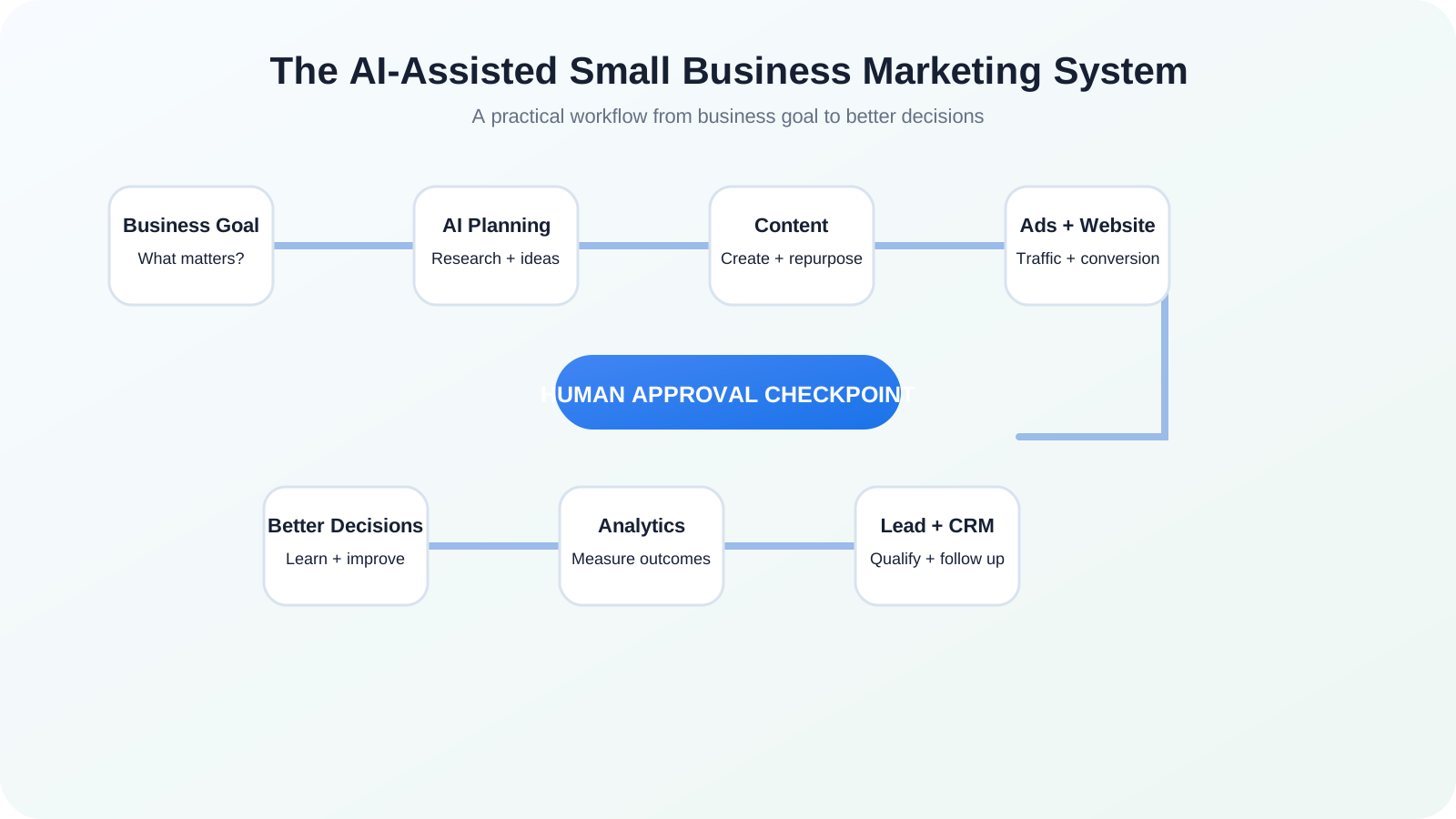
An AI-assisted workflow can potentially look like:
This doesn't eliminate humans.
It changes where humans spend their time.
7 Practical Ways Small Businesses Could Use AI Agents
1. Turn Business Goals Into Marketing Tasks
Instead of asking AI for random content, start with the business objective.
For example:
Goal: Generate more enquiries for website design services in Jalgaon.
Then break it down:
Local business owners
Old or ineffective websites
Website redesign / development
Educational posts
Lead-generation campaign
Website design service page
Enquiry / WhatsApp / call
This is much more useful than:
"Give me 10 posts."
2. Analyze Your Existing Marketing Before Creating More Content
One of the biggest problems in AI content marketing is creating more and more content without learning from existing performance.
A better system is:
For example:
Review:
- Reach
- Watch time
- Shares
- Saves
- Profile visits
### Meta Ads
Review:
- CTR
- CPC
- Leads
- Cost per lead
- Lead quality
### Website
Review:
- Traffic
- Engagement
- Conversion
- Top pages
- Enquiries
Then create the next content based on what you learned.
Meta's Muse announcement specifically describes connecting business information and tools so the agent can work with a business's broader context.
3. Use AI to Turn One Idea Into Multiple Content Assets
Suppose your business has one strong topic:
One core idea can become:
### Blog
5 Website Mistakes That Cost Businesses Leads
5 mistakes explained
### Instagram carousel
5 slides
### Reel
30-second version
### Story
Poll:
Website conversion checklist
### Ad
"Getting traffic but no enquiries?"
This is where AI can be genuinely useful.
The human's job becomes:
4. Connect Marketing With Sales
This is where AI-assisted workflows become more interesting.
Marketing doesn't end at:
A better system is:
For example, a local web-design business could receive:
"I need a website for my business."
The next questions might include:
- What type of business?
- How many pages?
- Do you already have a domain?
- Do you need ecommerce?
- What's your expected timeline?
- What location do you serve?
AI can help organize or draft responses, while a human handles important sales conversations.
5. Use AI for Competitive Research — Carefully
An AI agent can help structure research around:
- Competitor websites
- Social content
- Advertising themes
- Customer questions
- Market positioning
- Content gaps
But research still needs verification.
AI should not be allowed to invent:
- Competitor pricing
- Client numbers
- Reviews
- Campaign results
- Market statistics
- Testimonials
This is especially important for professional marketing content.
6. Improve Meta Ads With Better Feedback Loops
A common Meta Ads workflow is:
A stronger approach is:
For example:
Suppose an ad produces:
but only:
The correct response isn't automatically:
"Scale the campaign."
You need to ask:
Possibilities include:
- Wrong audience
- Weak offer
- Misleading creative
- Poor qualification
- Incorrect location
- Low-intent users
- Slow sales follow-up
AI can help analyze patterns, but the business still needs to decide what a good lead means.
7. Use AI to Reduce Repetitive Work
The strongest immediate use case for small businesses may simply be saving time.
Examples:
### Content
- Caption drafts
- Content calendars
- Repurposing
### Ads
- Creative variations
- Copy ideas
- Campaign summaries
### Website
- Content briefs
- FAQ drafts
- Page outlines
### SEO
- Topic clustering
- Content analysis
- Internal-link suggestions
### Sales
- Follow-up drafts
- FAQ responses
- Lead summaries
### Reporting
- Weekly performance summaries
- Trend identification
- Action lists
This doesn't mean all of these should be fully automated.
It means repetitive work can become easier.
The Biggest Mistake: Automating Before Building the System
This is extremely important.
Suppose your business has:
- No clear target customer
- No defined offer
- Poor website
- Weak tracking
- No CRM process
- Slow lead follow-up
Adding an AI agent doesn't fix those problems.
It may simply automate a bad process.
The correct sequence is:
Not:
AI Agent + Website: Why Your Website Still Matters
Some businesses may think:
"If AI can answer customers, why do I need a website?"
Because the website remains a central source of information.
It can communicate:
- Services
- Products
- Pricing information
- Locations
- FAQs
- Policies
- Brand information
- Contact options
- Case studies
- Original content
Google's current Search guidance continues to emphasize useful, crawlable and accessible website content, including for AI-powered Search experiences.
An AI agent is therefore better thought of as an additional operating layer.
Not a replacement for your digital foundation.
AI Agents + SEO: What Changes?
AI agents may change how marketers work, but that doesn't mean traditional SEO fundamentals disappear.
For example:
### Traditional SEO task
Find keywords.
### AI-assisted workflow
Research:
The objective remains:
Google's current documentation continues to emphasize people-first content and foundational SEO practices.
AI Agents + Local SEO
For a Jalgaon business, local information remains critical.
Your business data should be consistent across relevant platforms.
For example:
AI can help organize or audit this information.
But the underlying information must be accurate.
AI Agents + Lead Generation
This is where Vidyaitech can build a powerful service proposition.
Instead of selling:
"We run Meta Ads."
You can position the broader system as:
AI can support different steps.
### Example
This is closer to a business growth system than simply advertising.
What This Could Look Like for a Jalgaon Business
Imagine a local interior design business.
### Goal
Generate qualified home-interior enquiries.
### Step 1 — Content
Create Reels around:
- Kitchen design
- Bedroom design
- Budget planning
- Common mistakes
### Step 2 — Ads
Promote the strongest creative.
### Step 3 — Landing Page
Create:
### Step 4 — Lead
Customer submits:
- Location
- Property type
- Budget
- Requirement
### Step 5 — AI assistance
Summarize the enquiry.
### Step 6 — Human
Designer contacts the customer.
### Step 7 — Measurement
Track:
The AI isn't the business.
It is part of the system.
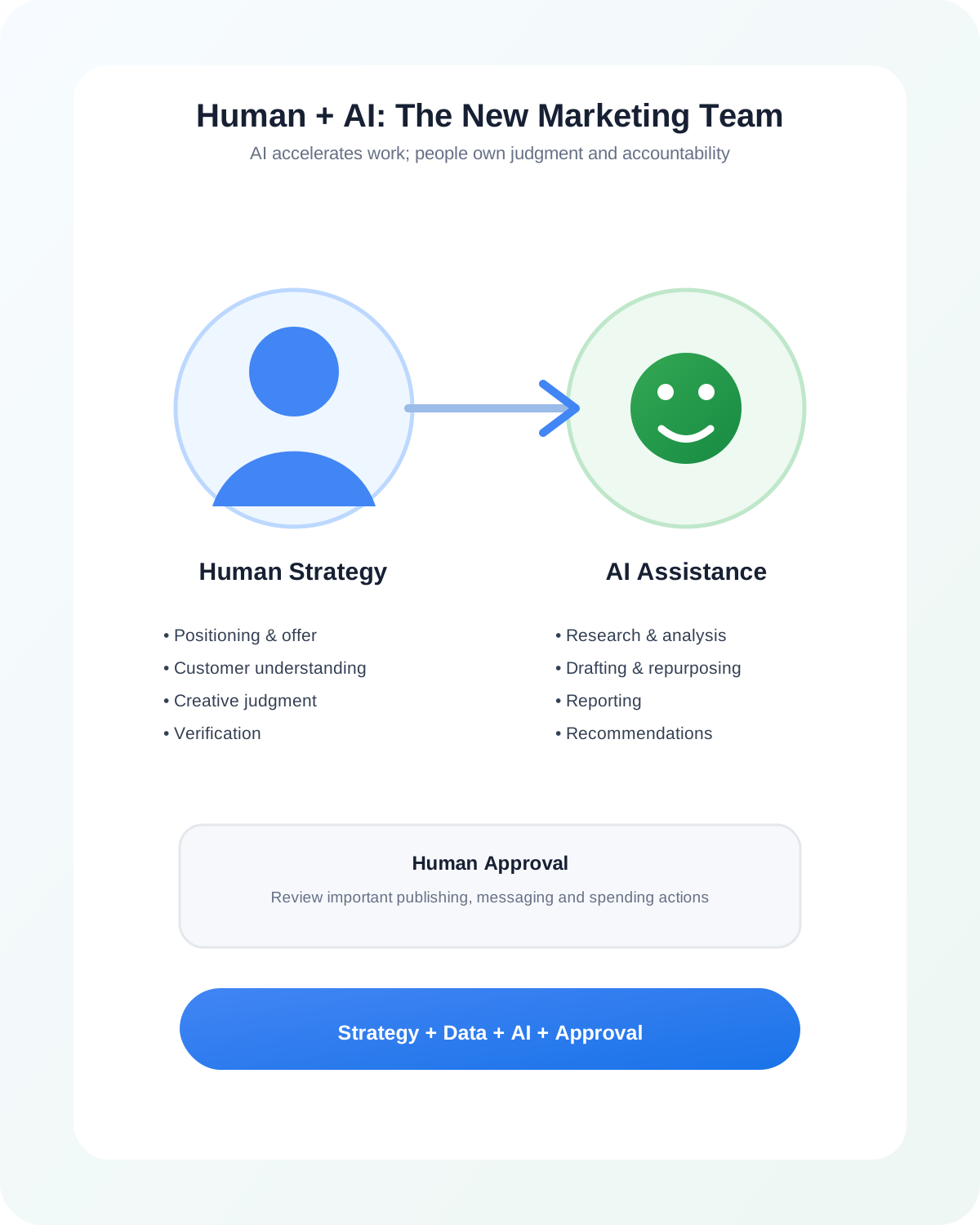
AI Agent vs Marketing Agency: Are They Competitors?
Not necessarily.
This is an important distinction.
An AI agent can help with:
A skilled marketer contributes:
For example, AI can produce:
"5 Instagram captions."
But a marketer should decide:
AI can analyze campaign data.
A marketer should ask:
AI can draft a landing page.
A marketer should decide:
That distinction becomes more important as AI tools become more capable.
A Practical AI Marketing Stack for a Small Business
A small business doesn't need 30 AI tools.
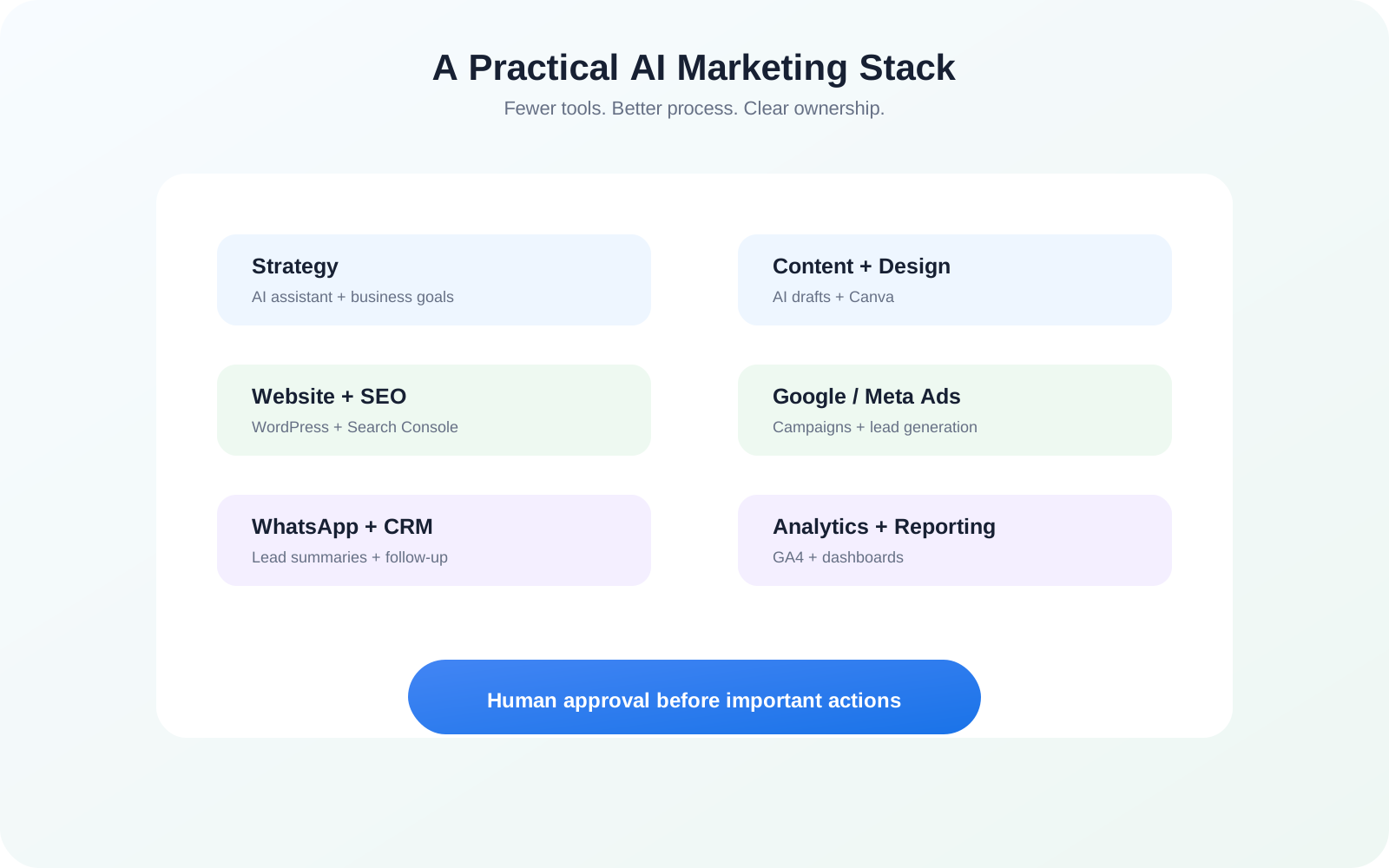
A simpler system can be:
| Function | Example |
|---|---|
| Strategy | AI assistant |
| Design | Canva |
| Website | WordPress |
| SEO | Google Search Console + SEO tools |
| Ads | Meta Ads / Google Ads |
| Messaging | WhatsApp Business |
| CRM | CRM platform |
| Analytics | GA4 |
| Content | AI + human editing |
| Reporting | Dashboard + AI summary |
The goal should be:
The Human Approval Rule
This is perhaps the most important rule for small businesses using AI agents:
Automate preparation before automating irreversible actions.
Good candidates for AI assistance:
- Research
- Analysis
- Drafting
- Summarization
- Recommendations
- Content variations
- Reporting
Higher-risk actions should generally retain human approval:
- Spending advertising budget
- Publishing brand communications
- Sending customer messages
- Changing prices
- Making financial decisions
- Deleting data
- Making contractual commitments
Meta specifically says Muse keeps the user in control and that nothing publishes, sends or spends without approval.
That is a useful principle beyond Muse itself.
What About Data Privacy?
AI agents can become more useful when they have access to more business information.
But that creates an obvious question:
Before connecting tools, businesses should understand:
- What information is shared
- What permissions are granted
- Who can access it
- What actions the system can take
- What approval controls exist
- How sensitive customer information is handled
Don't connect every tool simply because you can.
Start with the minimum information required for the job.
Is Meta Muse Available in India?
This requires an important distinction.
Meta announced Muse for Small Business globally as a product expansion, but availability, integrations, pricing and access can vary by market.
Separately, Meta has already launched Business AI on WhatsApp for eligible small businesses in India, with support for customer questions, product recommendations, lead capture and appointment-related interactions. Meta says the feature is available in Indian languages and businesses remain able to take over conversations from the AI.
Therefore, Indian businesses should not assume every Muse capability announced in September is immediately available to every Indian account.
Check the actual availability for your account and market before planning a workflow around a specific feature.
What This Means for Digital Marketers
The skill set of a digital marketer is changing.
Old model:
New model:
You increasingly need to understand:
- SEO
- Paid Ads
- Content
- Analytics
- Automation
- CRM
- Customer journeys
- AI agents
- Conversion optimization
Not necessarily to perform every task manually.
But to understand how the pieces connect.
30-Day AI Marketing Implementation Plan
Week 1 — Audit
Document:
- Marketing channels
- Tools
- Content workflow
- Lead workflow
- Ad workflow
- Reporting process
- Repetitive tasks
Find the tasks that consume the most time.
Week 2 — Build Your AI Workflow
Choose 3–5 repetitive tasks.
For example:
Task 1: Weekly social media performance summary
Task 2: Content repurposing
Task 3: Lead summary
Task 4: Ad performance analysis
Task 5: Blog-to-social transformation
Don't automate everything at once.
Week 3 — Connect Data Carefully
Connect only the tools you actually need.
For example:
or:
Keep permissions controlled.
Week 4 — Measure
Compare:
### Before AI assistance
- Time spent
- Content produced
- Reporting time
- Lead response time
### After AI assistance
- Time saved
- Output quality
- Errors
- Human review time
- Lead response
- Marketing performance
The objective isn't:
The objective is:
10 Questions Every Small Business Should Ask Before Using an AI Agent
- What business problem are we solving?
- What task currently takes too much time?
- What data does the AI need?
- Is that data accurate?
- What permissions will the AI have?
- What actions require human approval?
- How will we measure success?
- What happens if the AI makes a mistake?
- Can a human take over?
- Does the workflow actually improve the customer experience?
If you can't answer these questions, don't automate yet.
The Future Isn't "AI vs Humans"
A more realistic future is:
-
-
-
-
The competitive advantage won't necessarily belong to the business that uses the most AI tools.
It may belong to the business that builds the best system around them.
What Jalgaon Businesses Can Do Now
You don't need to wait for every AI feature to become available.
Start with the fundamentals.
### Step 1
Build a clear website.
### Step 2
Define your ideal customer.
### Step 3
Create a clear offer.
### Step 4
Set up reliable lead tracking.
### Step 5
Build a content system.
### Step 6
Use Google Ads and Meta Ads where appropriate.
### Step 7
Connect WhatsApp for conversations.
### Step 8
Use AI for repetitive work.
### Step 9
Keep humans responsible for important decisions.
### Step 10
Measure actual business outcomes.
Final Takeaway
Meta's announcement of Muse for Small Business on September 29, 2026 is another sign that AI is moving from a content-generation tool toward a broader business-operation layer.
For small businesses, the opportunity isn't simply:
It is:
A practical model is:
That's the direction small-business marketing is moving toward.
And businesses that learn how to combine human judgment + AI assistance + reliable data + strong digital foundations will be better prepared for what comes next.
Frequently Asked Questions
What is Meta Muse for Small Business?
Muse for Small Business is Meta's expanded AI-agent offering for small-business use. Meta says it can connect to business tools and accounts and work toward goals such as running a business or finding new customers.
Is Meta Muse the same as Meta Business AI?
No.
Meta Business AI on WhatsApp is a separate business-focused capability that Meta launched for eligible small businesses in India to help answer customer questions, recommend products, capture leads and support sales. Muse is a broader AI-agent product with integrations across business tools.
Can AI agents replace digital marketers?
Not completely.
They can automate or accelerate many repetitive tasks, but strategy, positioning, customer understanding, creative judgment, verification and business decisions still require human oversight.
Can AI agents run Meta Ads automatically?
Capabilities and permissions depend on the product, integration and account. Meta says Muse keeps users in control and does not publish, send or spend without approval.
Can Indian small businesses use AI for WhatsApp marketing?
Eligible Indian businesses can use Meta's Business AI on WhatsApp, which Meta says supports customer questions, recommendations, lead capture and appointment-related interactions. Availability depends on eligibility.
Should a small business connect all its tools to AI?
No.
Connect only the tools and data needed for the specific workflow. Review permissions and approval controls before connecting business information.
Will AI replace SEO?
No.
AI changes how marketers perform some SEO tasks, but useful content, crawlability, technical accessibility, internal linking, local relevance and user experience remain important.
Google's Search documentation continues to emphasize foundational SEO for modern Search experiences.
What is the best first AI automation for a small business?
Start with a repetitive, low-risk task such as:
- Reporting
- Content repurposing
- Research organization
- Lead summaries
- FAQ drafting
Then measure the time saved and quality before expanding.
Can AI help generate leads?
AI can support lead-generation workflows, but lead generation still depends on the offer, audience, advertising, website, conversion process and sales follow-up.
AI is a tool inside the system, not the entire system.
Is AI marketing useful for local businesses in Jalgaon?
Yes, particularly for businesses that need to manage multiple channels with limited resources.
A practical local-business system can combine:
Internal Linking Opportunities for Vidyaitech
1. Digital Marketing Services
Anchor: Digital Marketing Services in Jalgaon
https://vidyaitech.com/digital-marketing-services-in-jalgaon/
Suggested placement:
Businesses looking to combine SEO, paid advertising, social media and AI-assisted marketing can explore our Digital Marketing Services in Jalgaon.
2. Lead Generation
Anchor: Lead Generation Services in Jalgaon
https://vidyaitech.com/lead-generation-in-jalgaon/
Suggested placement:
AI can support the workflow, but businesses still need a reliable lead generation system to turn marketing activity into qualified enquiries.
3. Website Design
Anchor: website design and business growth
https://vidyaitech.com/why-website-design-matters-business-growth-in-2026/
Suggested placement:
AI cannot compensate for a confusing website, which is why website design and business growth should be addressed before adding automation.
4. About Vidyaitech
Anchor: learn more about Vidyaitech
https://vidyaitech.com/about-us/
5. Industries
Anchor: industries we serve
https://vidyaitech.com/Industries/
Explore Related Vidyaitech Services
Recommended Reading
For platform-specific features and SEO fundamentals, refer to the original documentation and verify availability for your account and market.